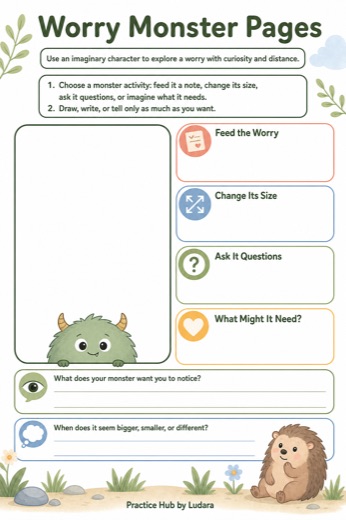
Anxiety Support · AN-01
Imagine a worry as a character and explore what it might say.
Search for a goal or age range, or filter by client group, format, and collection. Save pages to My Library to find them again on this device.
Anxiety Support · AN-01
Imagine a worry as a character and explore what it might say.
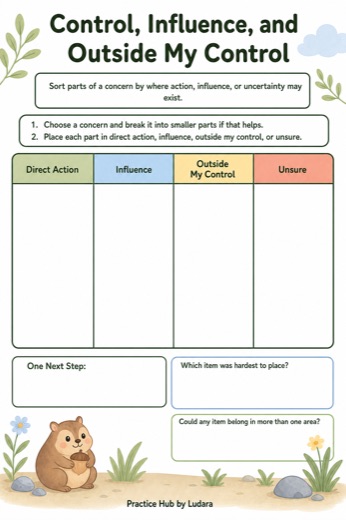
Anxiety Support · AN-02
Take a concern apart: what can you do, what can you influence, and what is outside your control or still unclear?
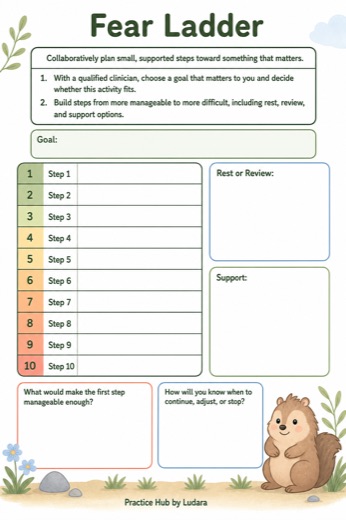
Anxiety Support · AN-03
Work with a clinician to plan small, supported steps toward a goal that matters to you.
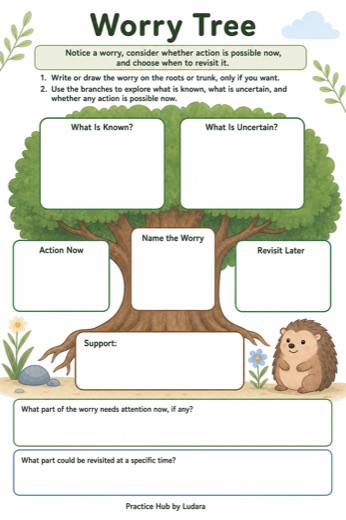
Anxiety Support · AN-04
Put a worry on the page and decide whether it needs action now, support, or another look later.
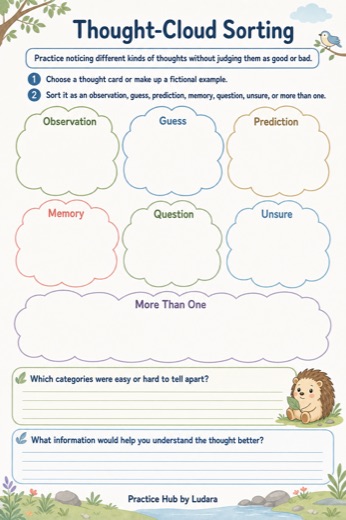
Anxiety Support · AN-05
Sort thoughts into different kinds, without having to call them good or bad.
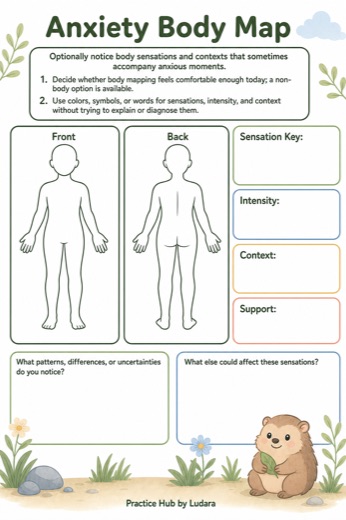
Anxiety Support · AN-06
If paying attention to your body feels comfortable, explore sensations you sometimes notice when anxious and what else is happening at the time.
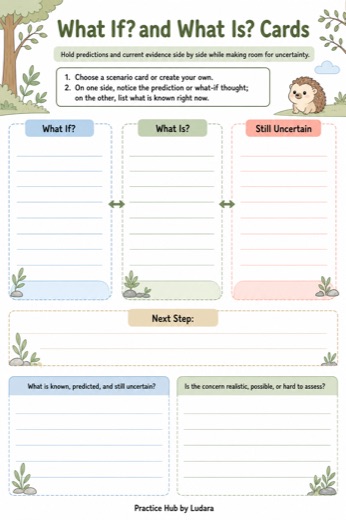
Anxiety Support · AN-07
Set a what-if thought beside what you know right now, with space for what you still cannot tell.
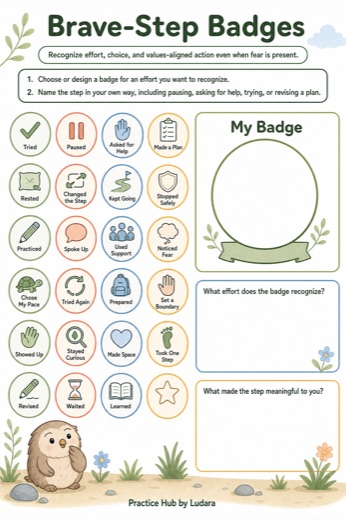
Anxiety Support · AN-08
Make a badge for an effort or choice that matters to you. Fear does not have to disappear for the step to count.
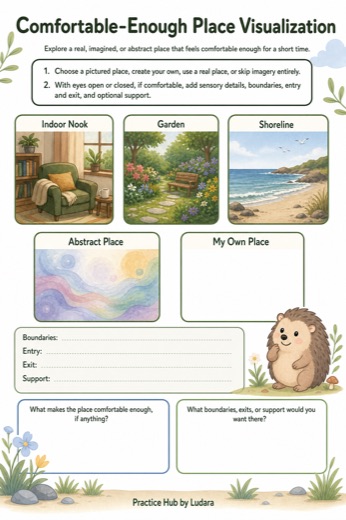
Anxiety Support · AN-09
Explore a real, imagined, or abstract place that feels comfortable enough for now. You can skip imagery entirely.
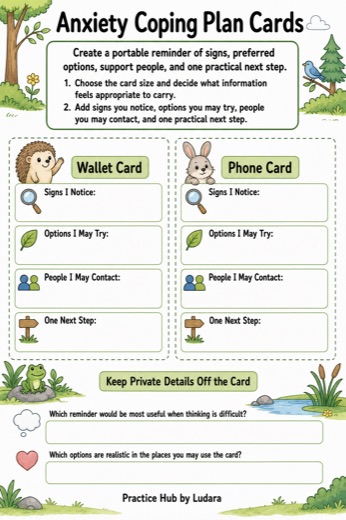
Anxiety Support · AN-10
Make a card you can carry with signs of anxiety you notice, coping options you prefer, people you can contact, and a practical next step.
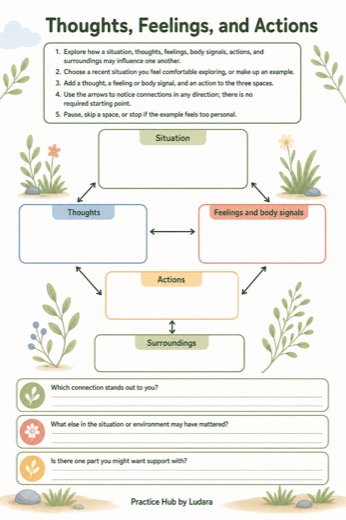
CBT-Informed Activities · CB-01
Map a situation and look at how thoughts, feelings, body signals, actions, and surroundings may connect.
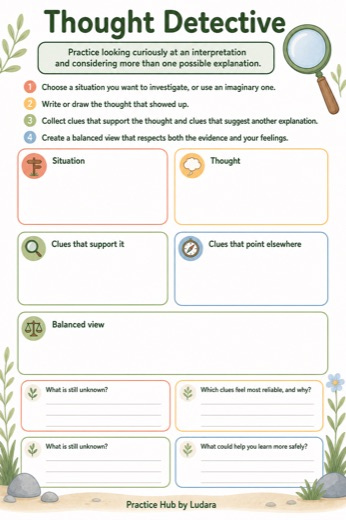
CBT-Informed Activities · CB-02
Look for clues that support a thought and clues that suggest another explanation.
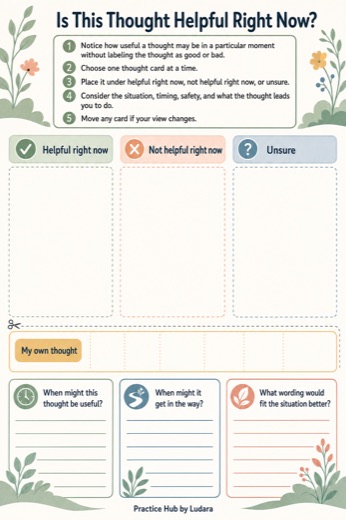
CBT-Informed Activities · CB-03
Ask whether a thought is useful in this moment. The answer can change with the situation.
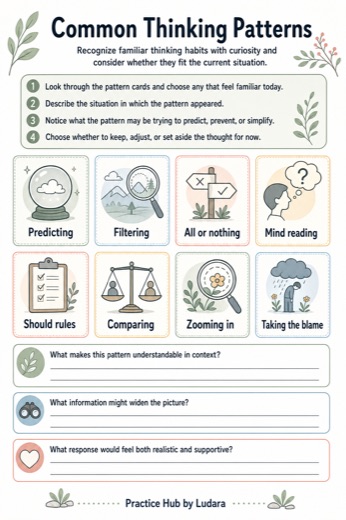
CBT-Informed Activities · CB-04
Look at familiar thinking habits and ask whether they fit what is happening today.
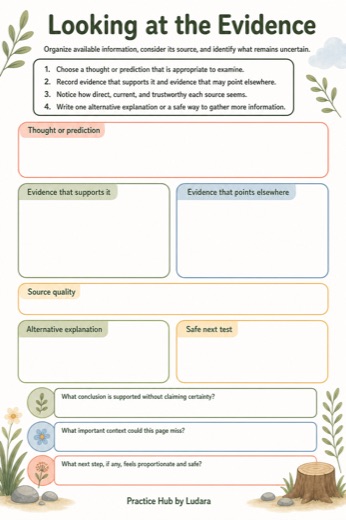
CBT-Informed Activities · CB-05
Lay out the information you have, where it came from, and what you still do not know.
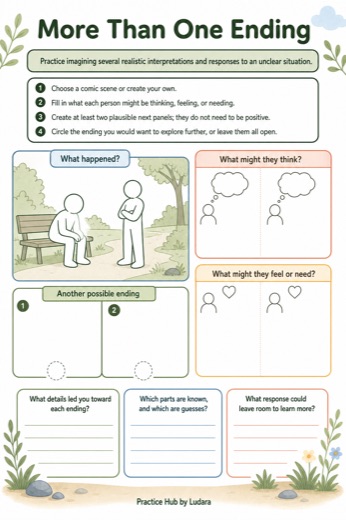
CBT-Informed Activities · CB-06
Give an unclear scene more than one possible ending, with realistic thoughts and responses along the way.
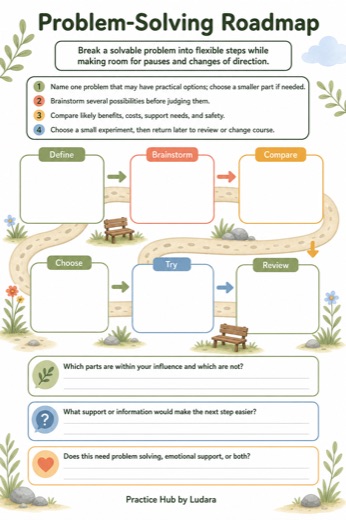
CBT-Informed Activities · CB-07
Take a practical problem one step at a time, with room to pause or choose a different route.
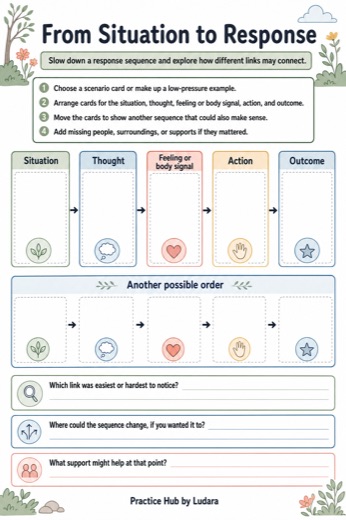
CBT-Informed Activities · CB-08
Use cards to look at what happened in a situation, what someone noticed, and what came next.
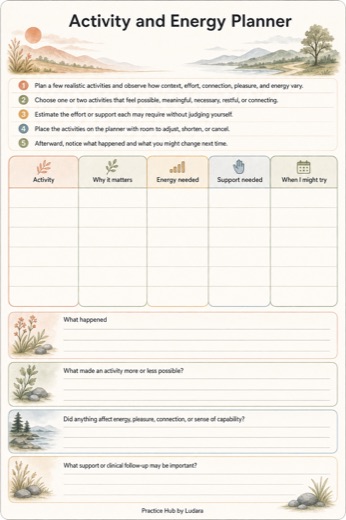
CBT-Informed Activities · CB-09
Plan a few activities that feel possible, then notice how effort, energy, pleasure, connection, and circumstances shape the experience.
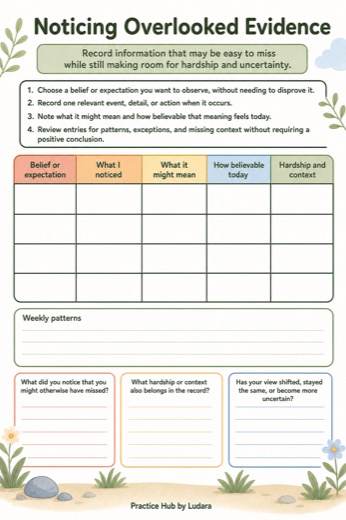
CBT-Informed Activities · CB-10
Keep a record of details you might otherwise miss, alongside the difficulties and unanswered questions that still matter.
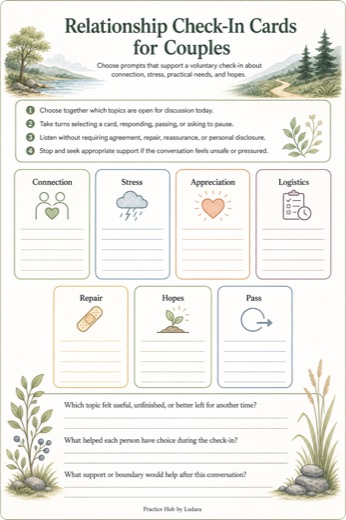
Couples & Family · CF-01
Choose a few cards for a voluntary conversation about connection, stress, everyday needs, or hopes.
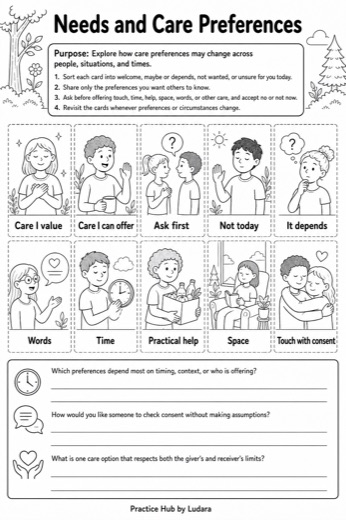
Couples & Family · CF-02
Talk about what kinds of care feel welcome today, knowing that preferences can change with the person and situation.
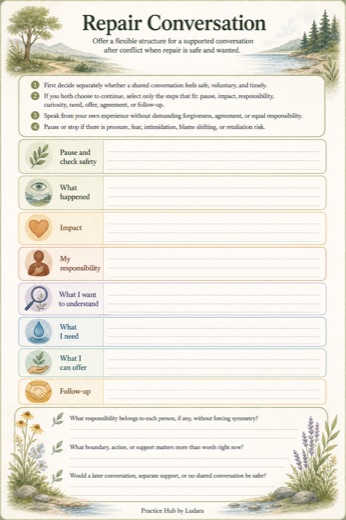
Couples & Family · CF-03
Plan a supported conversation after conflict, only when repair is safe and everyone taking part wants it.
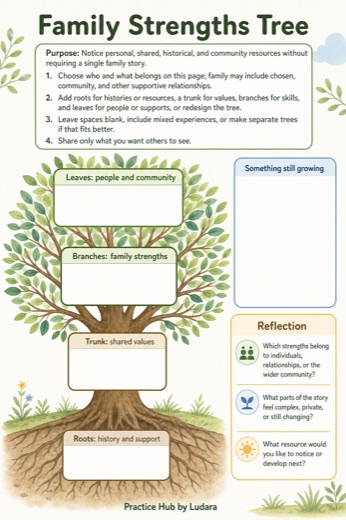
Couples & Family · CF-04
Build a picture of personal, family, historical, and community strengths. Different people can tell different stories.

Couples & Family · CF-05
Use a shared board to offer a feeling, need, privacy preference, or time to check back. Joining in is optional.

Couples & Family · CF-06
Compare the values that matter to each person, with room for shared choices, differences, and changing minds.

Couples & Family · CF-07
With a clinician, map an interaction that keeps repeating. Consider how power, impact, and responsibility differ between the people involved.

Couples & Family · CF-08
Name an action you appreciate and what it meant to you, if that feels right today. Difficulties do not need to be set aside.

Couples & Family · CF-09
Consider a goal together and work out whether it is truly shared, who would do what, and what each person can agree to.

Couples & Family · CF-10
Make household work visible: who notices it, plans it, does it, makes decisions, and follows up.
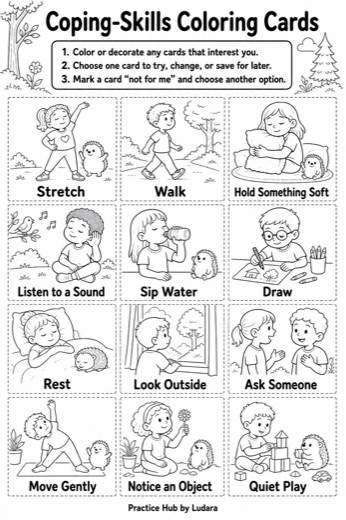
Coping & Regulation · CR-01
Color a few coping cards and choose which ideas you might like to try, change, or leave for later.
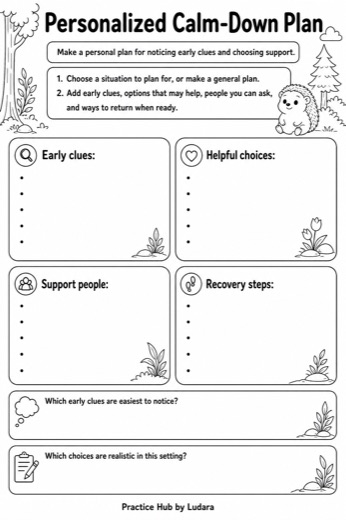
Coping & Regulation · CR-02
Make a plan in your own words for noticing early clues and choosing the support you want.
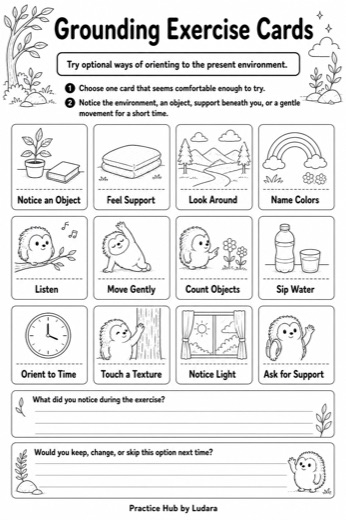
Coping & Regulation · CR-03
Try a brief way of noticing where you are, using an option that feels comfortable enough.
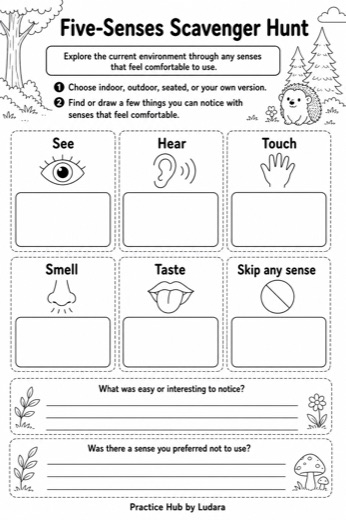
Coping & Regulation · CR-04
Go looking for things you can notice around you, using only the senses that feel comfortable and available.

Coping & Regulation · CR-05
Trace a simple shape while breathing naturally, or try gentle pacing if it feels comfortable.

Coping & Regulation · CR-06
Notice tension, release, or supported rest in a way that fits your body, without strain or a need to tense muscles.

Coping & Regulation · CR-07
Show the choices a supportive space can actually offer, so a child can see what is available.

Coping & Regulation · CR-08
Use a bingo board to try or talk about coping ideas together, without a race to finish.

Coping & Regulation · CR-09
Build a toolbox of coping ideas you can keep, change, or use in different situations.

Coping & Regulation · CR-10
Point to, look at, sign, or say the support you want when finding words is difficult.
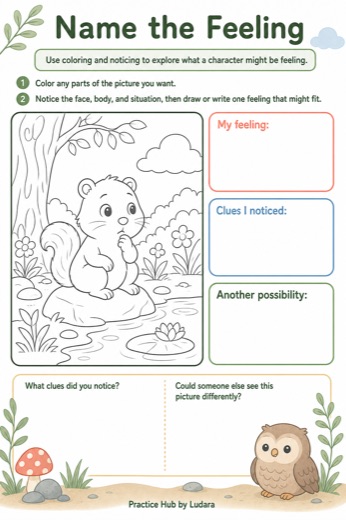
Emotional Awareness · EA-01
Color a character and wonder what they might be feeling. More than one answer may fit.
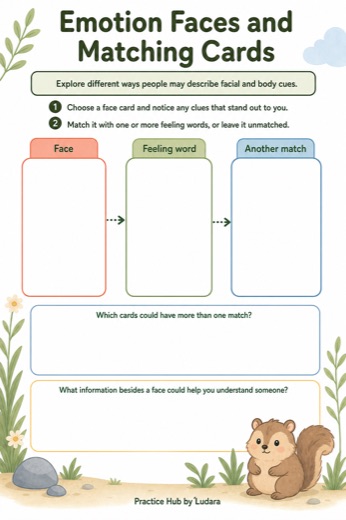
Emotional Awareness · EA-02
Match faces and body cues with possible feeling words, and talk about what else you would need to know.
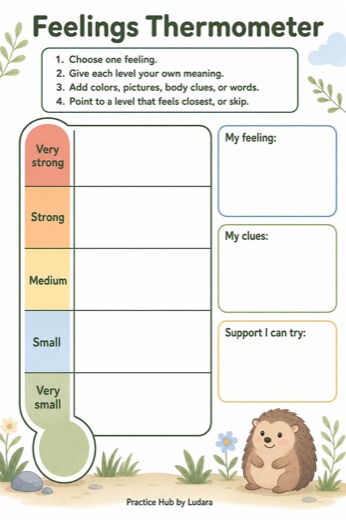
Emotional Awareness · EA-03
Give a feeling its own thermometer, using your words and pictures for different levels of intensity.
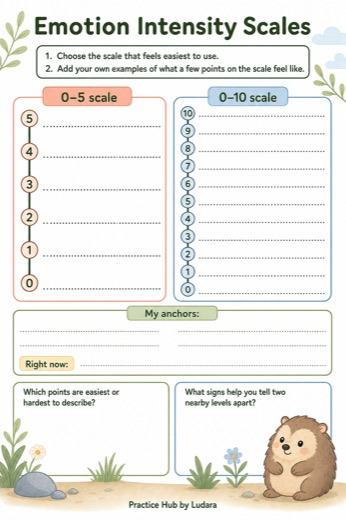
Emotional Awareness · EA-04
Make a scale that describes how strong a feeling is for you, using examples from your own experience.

Emotional Awareness · EA-05
Explore whether you notice a feeling anywhere in your body, with a non-body option if that fits better.

Emotional Awareness · EA-06
Wonder what a feeling might be telling you, then choose how you want to respond.

Emotional Awareness · EA-07
Look around the wheel for words that come close to how you feel. Choose several, add your own, or pass.

Emotional Awareness · EA-08
Keep feeling words and symbols nearby to help describe an emotion. You can choose a word or add your own.

Emotional Awareness · EA-09
Imagine a feeling as a creature and decide what it looks like, how it moves, and what it might need.

Emotional Awareness · EA-10
Check in before and after an activity to notice differences, no change, or anything that is hard to tell.
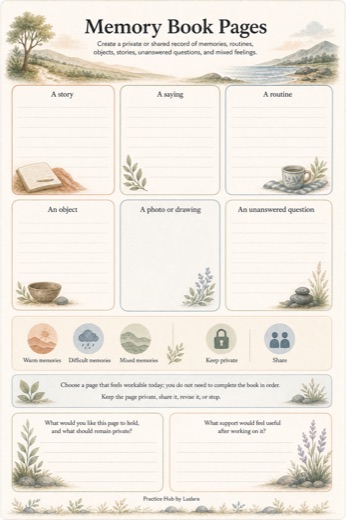
Grief & Life Transitions · GR-01
Make a book for memories, everyday details, questions, and mixed feelings. You decide what stays private.
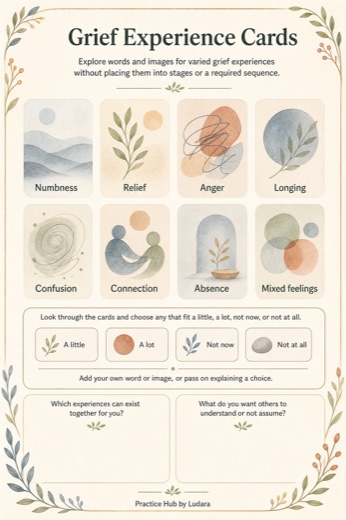
Grief & Life Transitions · GR-02
Choose words or pictures that fit your experience of grief, without putting them into stages or an order.
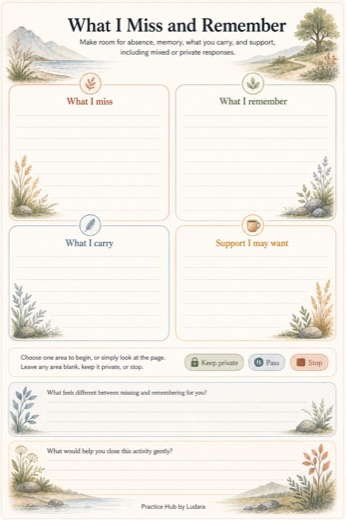
Grief & Life Transitions · GR-03
Use separate spaces for what you miss, what you remember, what you carry forward, and the support you want. Any part can stay blank or private.
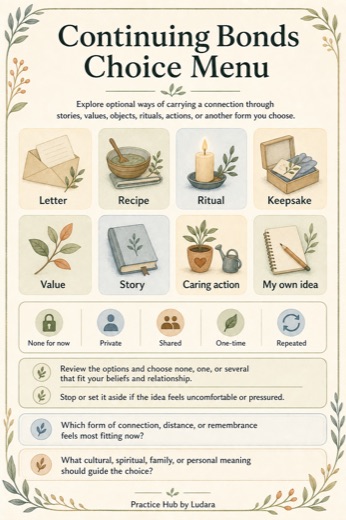
Grief & Life Transitions · GR-04
Consider ways to carry a connection through a story, object, value, ritual, or action, if any of those feel right for you.

Grief & Life Transitions · GR-05
Map changes, losses, gains, support, and unknowns without needing a straight line or a positive ending.

Grief & Life Transitions · GR-06
Spend time coloring a tree. It can hold memories or meaning, or simply be a page you want to color.

Grief & Life Transitions · GR-07
Map the people, places, routines, and services that might support you in grief, including how to reach them and what could get in the way.

Grief & Life Transitions · GR-08
Put unfinished words somewhere private: things you remember, appreciate, regret, question, or cannot yet make sense of.

Grief & Life Transitions · GR-09
Plan a remembrance or other observance, if you want one, around the people, beliefs, access, safety, and support that matter to you.

Grief & Life Transitions · GR-10
Choose a small, realistic form of care, rest, connection, remembrance, practical help, or support. Feeling better is not a requirement.
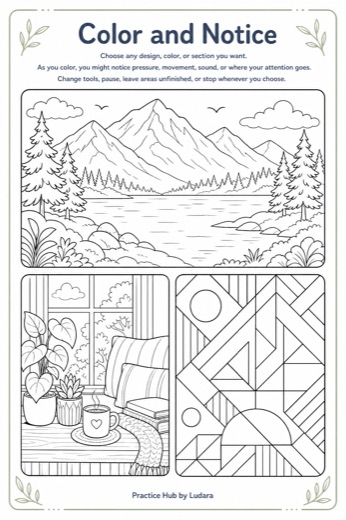
Mindfulness & Grounding · MF-01
Color if you want to, and notice your pace, movement, attention, or choices along the way.
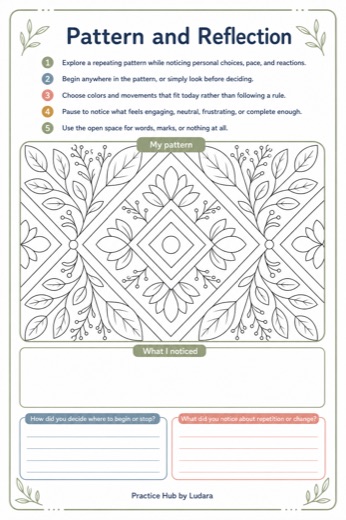
Mindfulness & Grounding · MF-02
Spend time with a repeating pattern and notice how you choose colors, find a pace, or decide you have had enough.
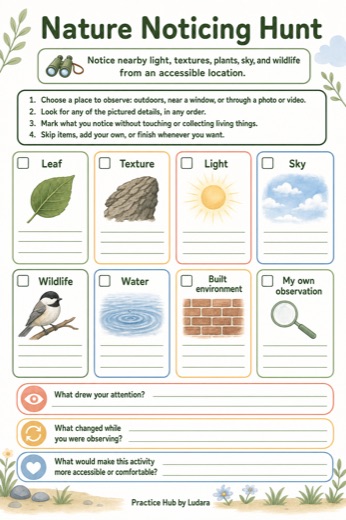
Mindfulness & Grounding · MF-03
Look for light, textures, plants, sky, or wildlife from a place you can comfortably access.
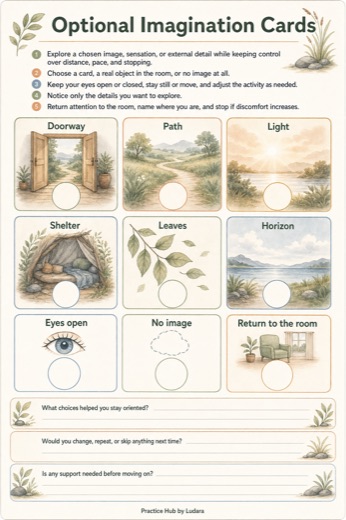
Mindfulness & Grounding · MF-04
Choose an image, sensation, or detail in the room to explore, keeping control of the pace, distance, and when to stop.

Mindfulness & Grounding · MF-05
Explore the sensory details of an object, or food when appropriate. Tasting, touching, and continuing are all optional.

Mindfulness & Grounding · MF-06
Trace a hand or another path at your own pace, letting your breath stay natural and comfortable.

Mindfulness & Grounding · MF-07
Make a garden for people, moments, places, strengths, or hopes you value, with room for what is difficult too.

Mindfulness & Grounding · MF-08
Notice a few details in the space around you through whichever senses or supports feel comfortable and available.

Mindfulness & Grounding · MF-09
Keep notes on when an attention or meditation practice fits your life. There is no streak to keep or minimum time to reach.

Mindfulness & Grounding · MF-10
Roll for a brief noticing idea, or choose one yourself. You can change the suggestion or pass.
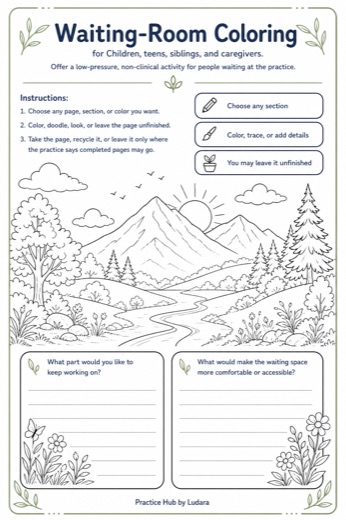
Practice-Facing Resources · PF-01
Offer something simple to color, doodle on, or look at while waiting at the practice.
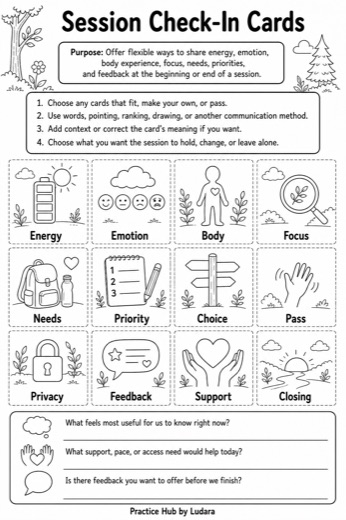
Practice-Facing Resources · PF-02
Start or close a session with cards for feelings, energy, needs, priorities, body experiences, focus, or feedback.
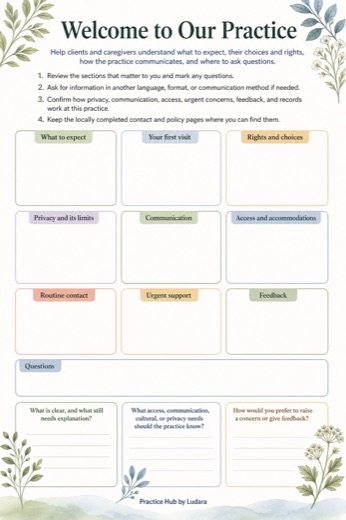
Practice-Facing Resources · PF-03
Walk clients and caregivers through what to expect, the choices and rights they have, and how to ask the practice a question.
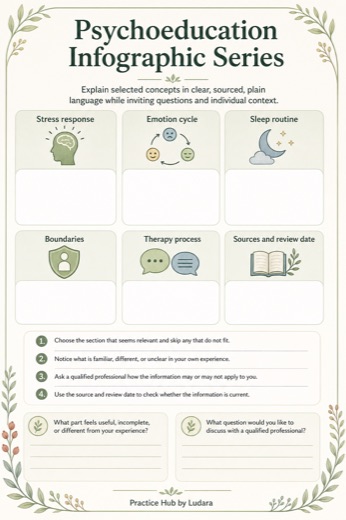
Practice-Facing Resources · PF-04
Explain a selected concept in plain language with sources, space for questions, and room for individual experiences.

Practice-Facing Resources · PF-05
Plan a group with a clear purpose, agreements, accessible activities, ways to pass, and time to close.

Practice-Facing Resources · PF-06
Agree on one small step to try between sessions. At the next session, discuss what happened and whether to change the plan.

Practice-Facing Resources · PF-07
Keep brief reminders of prompts, pacing, grounding choices, group questions, and adaptations within reach during sessions.

Practice-Facing Resources · PF-08
Show the sensory, movement, rest, communication, and return choices that a voluntary supportive space can offer.

Practice-Facing Resources · PF-09
Build a workshop workbook around what people will learn, try, discuss, and take away, with clear limits on its use.

Practice-Facing Resources · PF-10
Create matching worksheets, cards, posters, workbooks, and guides while keeping the required source, ownership, and review details attached.
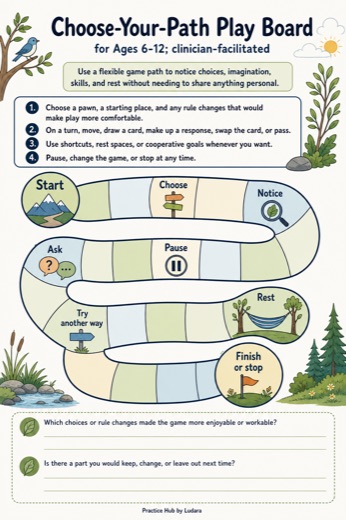
Play Therapy · PT-01
Make your way around a play board with choices, imagination, skills, and rest. Personal sharing is never needed to play.
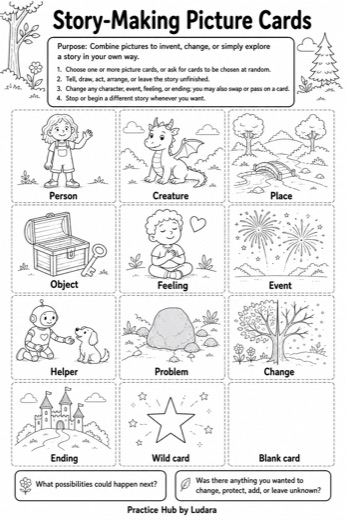
Play Therapy · PT-02
Pick some pictures and see what story you want to make. You can change it, arrange it quietly, or leave it unfinished.
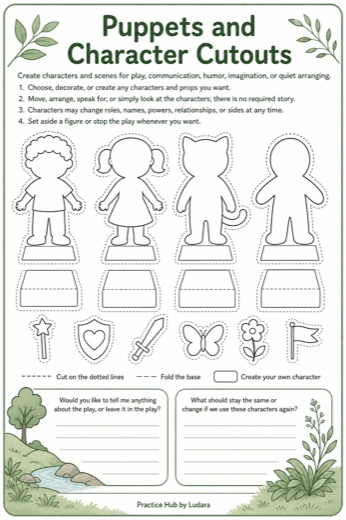
Play Therapy · PT-03
Make characters for stories, jokes, imaginative scenes, communication, or simply moving the pieces around.
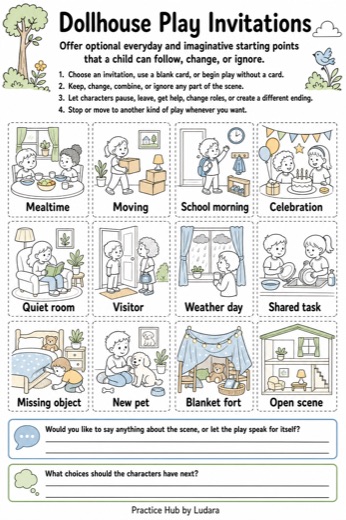
Play Therapy · PT-04
Offer a few everyday or imaginary scenes to begin dollhouse play. The child can change every part or ignore the cards.

Play Therapy · PT-05
Follow clues at a comfortable pace to notice surroundings, preferences, sensory details, strengths, or support.

Play Therapy · PT-06
Travel through a maze with feelings, helpers, choices, and rest stops. A feeling can come along for the journey.

Play Therapy · PT-07
Choose what happens next in a story, try a different ending, or leave the scene open.

Play Therapy · PT-08
Design a place with the surroundings, boundaries, helpers, and sensory choices you want. It only needs to feel comfortable enough.

Play Therapy · PT-09
Invent a hero who can use tools, set boundaries, ask the team for help, make mistakes, and rest.

Play Therapy · PT-10
Offer a badge for something the child chooses to recognize, whether that is trying, resting, asking for help, or changing course.
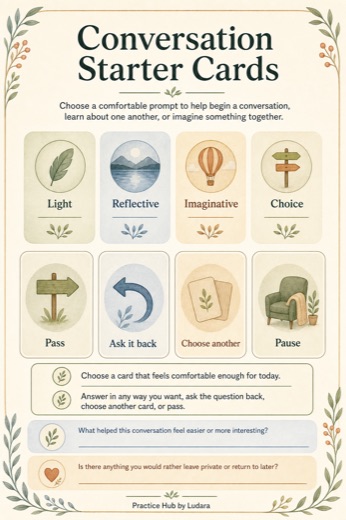
Social & Communication · SC-01
Pick a comfortable question to start talking, learn a little about each other, or imagine something together.
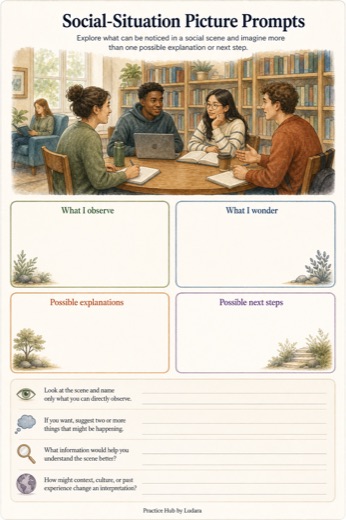
Social & Communication · SC-02
Look at a social scene, separate what you can see from what you are guessing, and consider a few possibilities.
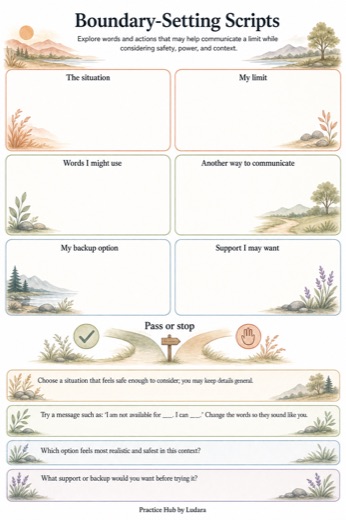
Social & Communication · SC-03
Try words or actions for setting a limit, with safety, power, and the situation guiding the choices.
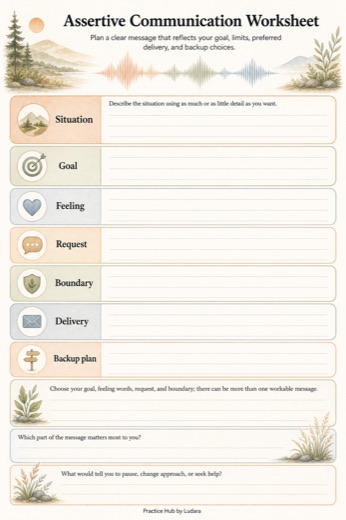
Social & Communication · SC-04
Plan what you want to say, what you are asking for, how to deliver it, and what you could do if that approach does not fit.

Social & Communication · SC-05
Sort choices by whether they fit a situation or need another look. New information can change where a card belongs.

Social & Communication · SC-06
Look at friendship patterns over time, with room for context, repair, boundaries, and distance when needed.

Social & Communication · SC-07
Imagine a few possible viewpoints in a scene, remembering that a picture cannot tell you what someone is thinking.

Social & Communication · SC-08
Find a safe route through an everyday disagreement, including pausing, leaving, seeking help, or repairing when wanted.

Social & Communication · SC-09
Play with different ways to receive a message, check what it means, and clear up a misunderstanding.

Social & Communication · SC-10
Combine faces, body cues, words, and situations to explore possible feelings. A match is a possibility, not proof of what someone feels.
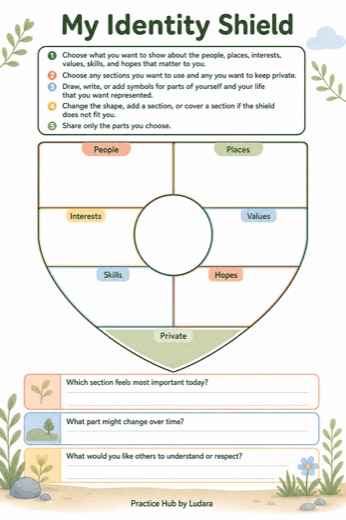
Self-Esteem & Identity · SI-01
Fill a shield with the people, places, interests, values, skills, or hopes you want to show. You choose what belongs.
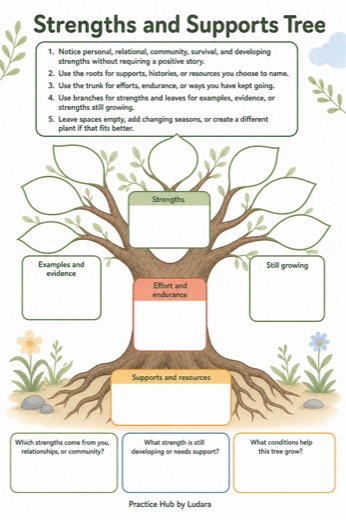
Self-Esteem & Identity · SI-02
Build a tree of personal strengths and support from relationships, history, and community, without needing to make it a positive story.
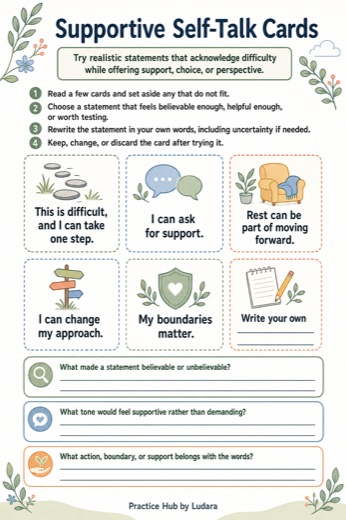
Self-Esteem & Identity · SI-03
Try words of support that you can actually believe, with space for difficulty, uncertainty, and choices.
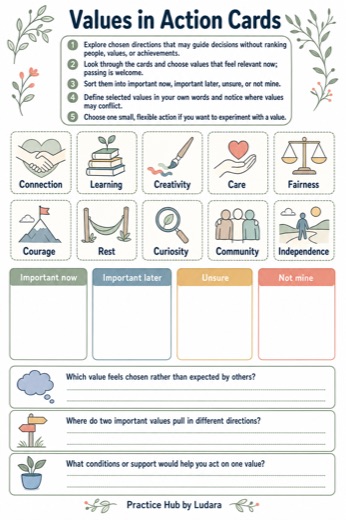
Self-Esteem & Identity · SI-04
Choose values that matter to you and consider how they might guide a decision. They are not a way to rank people.

Self-Esteem & Identity · SI-05
Color or draw the interests, ways of learning, people, communities, cultures, and dreams you want to share about yourself.

Self-Esteem & Identity · SI-06
Give a character ways to act with support, even when they feel unsure, afraid, or likely to make a mistake.

Self-Esteem & Identity · SI-07
Save reminders of effort, care, rest, repair, learning, connection, or asking for help. You can include something you finished, but you do not need an achievement to add a note.

Self-Esteem & Identity · SI-08
Listen to the tone of self-talk and try a response, action, or request for support that feels more respectful.

Self-Esteem & Identity · SI-09
Choose a difficulty that feels manageable to reflect on, then try responding to yourself with respect. You decide how close to the experience to get and what support you need.

Self-Esteem & Identity · SI-10
Make a collage of different parts of yourself, with space for overlap, privacy, contradictions, and change.
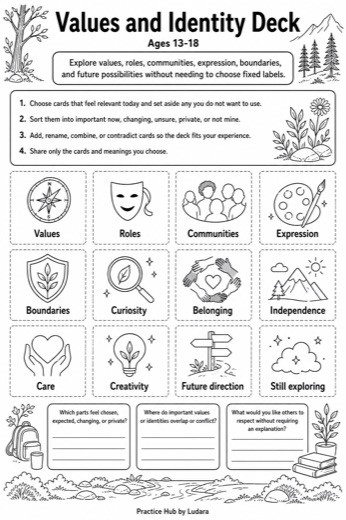
Teen-Focused Resources · TE-01
Sort cards about values, roles, communities, expression, boundaries, and possibilities without having to settle on a label.
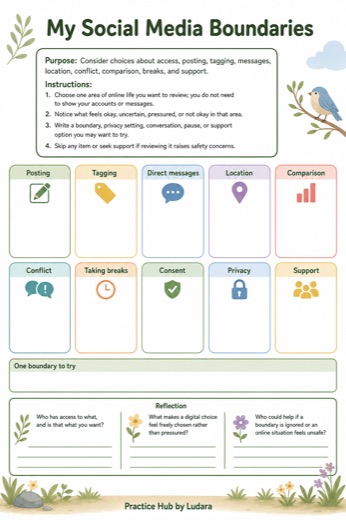
Teen-Focused Resources · TE-02
Look at the parts of online life you want more say over, from messages and tags to location sharing, breaks, and support.
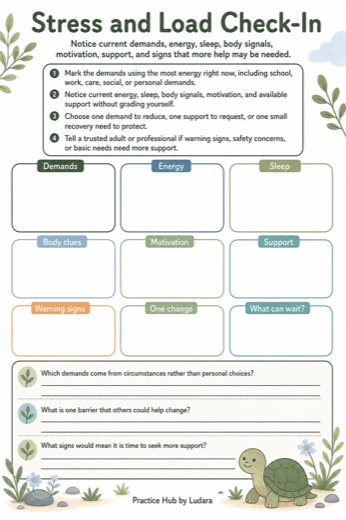
Teen-Focused Resources · TE-03
Look at the demands taking your energy, how you are doing, and where you need support.
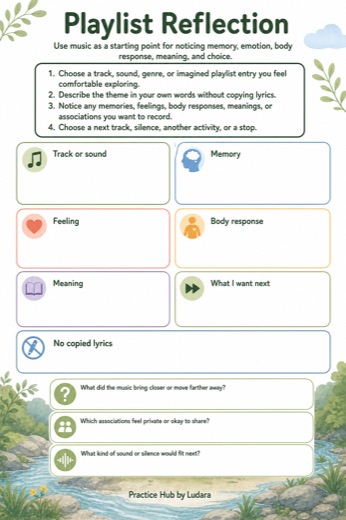
Teen-Focused Resources · TE-04
Start with a song, sound, or playlist. Talk about any memories, feelings, body responses, or meanings it brings up, and what you want to do next.

Teen-Focused Resources · TE-05
Look at relationship patterns in context, including consent, respect, control, repair, privacy, and support, without blaming someone for harm done to them.

Teen-Focused Resources · TE-06
Write a note to your future self about values, hopes, questions, and support. You do not need to know how things will turn out.

Teen-Focused Resources · TE-07
Work through a fictional situation by weighing choices, values, consequences, uncertainty, power, and available support.

Teen-Focused Resources · TE-08
Plan for school and other demands, including the effort involved, barriers, breaks, accommodations, and help you may need.

Teen-Focused Resources · TE-09
Choose an action that offers care or protection and fits the time, energy, money, access, and support you have.

Teen-Focused Resources · TE-10
Choose a journal prompt about identity, relationships, values, coping, or creativity, and decide how to respond and what you want to keep private.
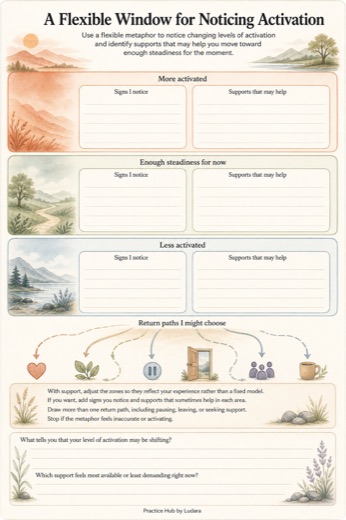
Trauma-Informed Resources · TI-01
Use the window as a starting point to describe changes in your level of activation. Adjust it to fit your experience and note support that may help you feel steady enough for now.
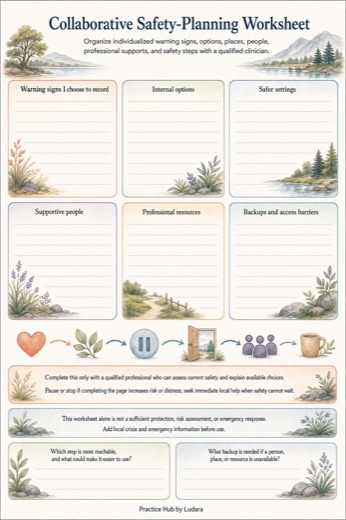
Trauma-Informed Resources · TI-02
With a qualified clinician, put individualized warning signs, options, safer places, people, professional support, and safety steps into a plan.
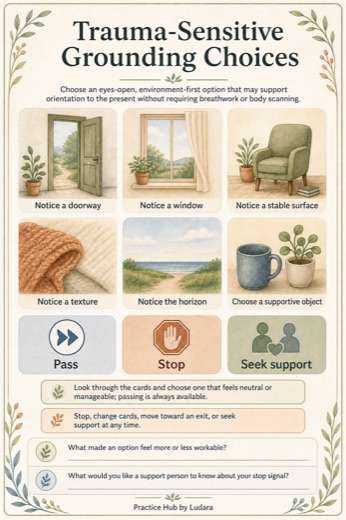
Trauma-Informed Resources · TI-03
Choose a brief way to notice the room with your eyes open, without having to focus on breathing or scan your body.
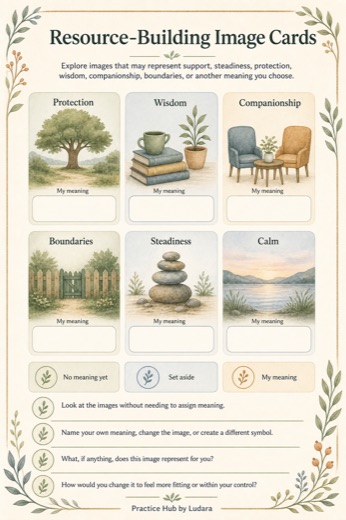
Trauma-Informed Resources · TI-04
Choose an image that suggests support, steadiness, protection, companionship, wisdom, or boundaries to you, or give it your own meaning.

Trauma-Informed Resources · TI-05
Map possible support, how you could reach it, and what backup you might need. No one has to belong in the closest circle.

Trauma-Informed Resources · TI-06
Make it easier to see and ask for the choices a service or group can genuinely offer.

Trauma-Informed Resources · TI-07
Explore what feels okay around physical space, emotions, time, and digital contact, with room for exceptions and safer alternatives.

Trauma-Informed Resources · TI-08
Choose a brief stabilization option with a clinician. Agree on how to stop or ask for support, then try it together.

Trauma-Informed Resources · TI-09
If reflection feels right, consider what helped you get through, what it cost, and what support or change you want now.

Trauma-Informed Resources · TI-10
With a clinician, decide whether to try setting material aside temporarily. Keep control over access and plan when to return to it and what support you will need.
Try a different word or clear a filter to see more of the collection.