Social & Communication · SC-07
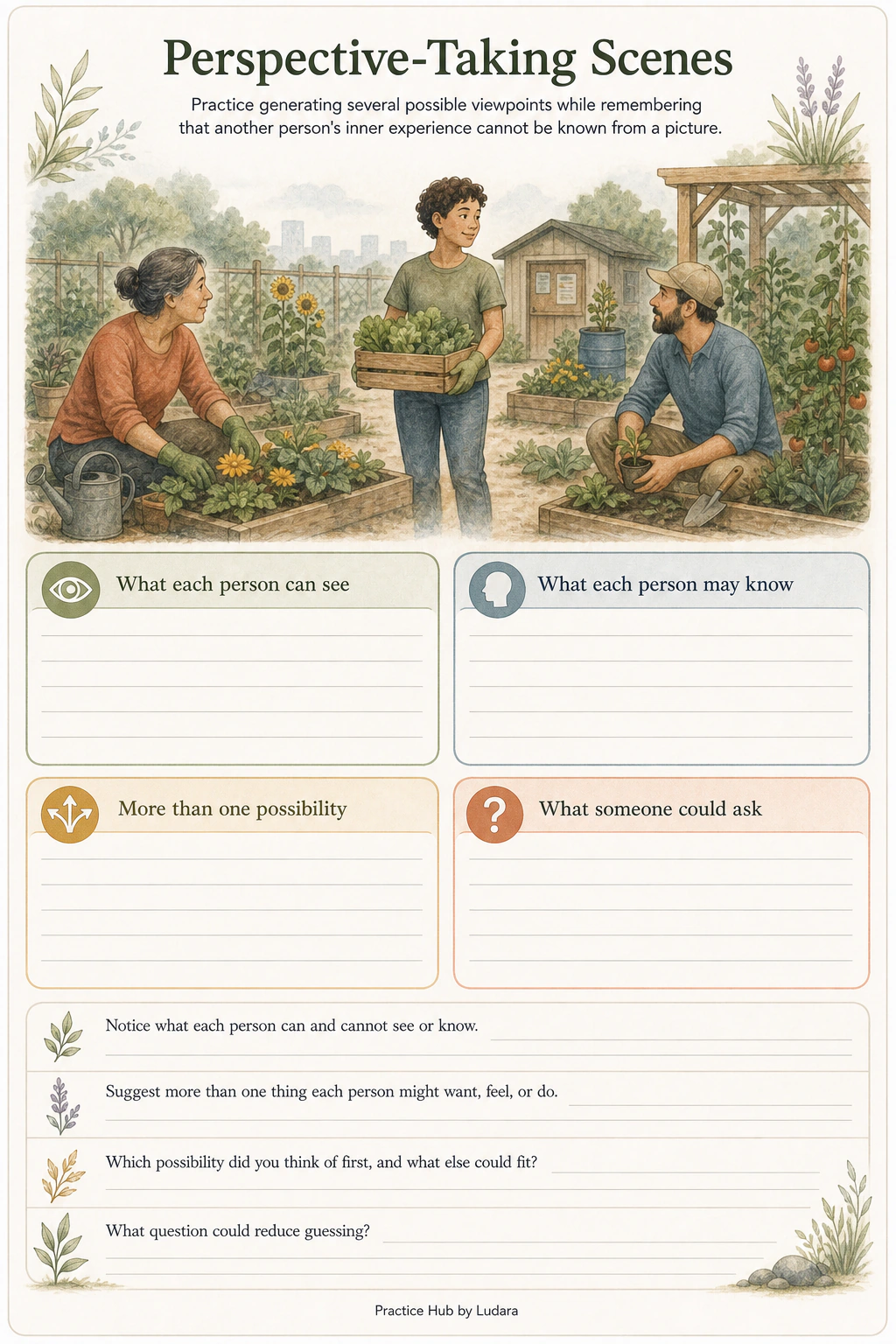
Perspective-Taking Scenes
Practice generating several possible viewpoints while remembering that another person's inner experience cannot be known from a picture.
Clinician-created · facilitator review requiredFor clinician-facilitated use
This is a professional resource, not a child-facing online service. A licensed clinician or other qualified adult must determine suitability, explain and adapt the activity, and supervise its use. Do not direct a child to access this webpage independently or enter client information.
The full-resolution WebP includes print-safe margins and should be downloaded by an adult professional. Read the guidance below before using the page.
How to use it
- Notice what each person can and cannot see or know.
- Suggest more than one thing each person might want, feel, or do.
- Mark guesses as possibilities, then choose what someone could ask or check.
Reflection prompts
- Which possibility did you think of first, and what else could fit?
- What question could reduce guessing?

Facilitator guidance
Use possibility language consistently and avoid treating facial expression, posture, or neurotypical conventions as proof. Praise flexible hypothesis generation and respectful checking rather than selecting a single correct mental state.
Adaptations & accessibility
- Provide visual possibility tokens or emotion-word choices.
- Reduce the number of characters or questions.
- Allow the participant to describe only visible facts and skip inner-state guesses.
Professional-use review
Licensed-clinician and neurodiversity-informed review required before use; ensure the activity does not reward mind-reading or social masking.