Social & Communication · SC-03
Boundary-Setting Scripts
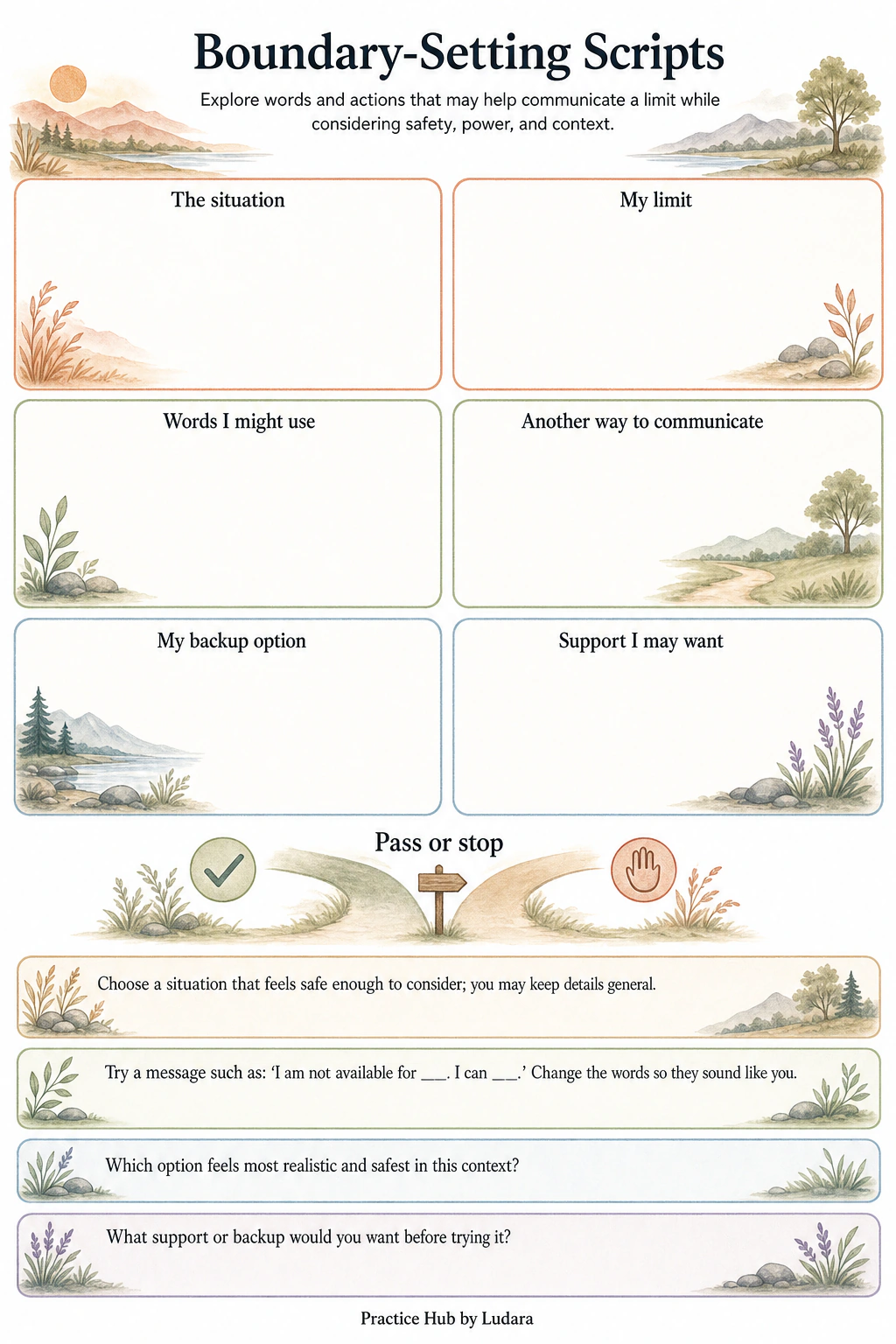
Explore words and actions that may help communicate a limit while considering safety, power, and context.
Clinician-created · specialist review requiredFor clinician-facilitated use
This is a professional resource, not a child-facing online service. A licensed clinician or other qualified adult must determine suitability, explain and adapt the activity, and supervise its use. Do not direct a child to access this webpage independently or enter client information.
The full-resolution WebP includes print-safe margins and should be downloaded by an adult professional. Read the guidance below before using the page.
How to use it
- Choose a situation that feels safe enough to consider; you may keep details general.
- Try a message such as: ‘I am not available for ___. I can ___.’ Change the words so they sound like you.
- Choose a backup option, such as delaying, leaving, using digital controls, documenting, or asking a support person.
- Pass or stop if rehearsal increases concern or discomfort.

Reflection prompts
- Which option feels most realistic and safest in this context?
- What support or backup would you want before trying it?

Facilitator guidance
Assess safety, power differences, retaliation risk, dependence, and cultural context before rehearsal. Direct verbal assertion is not always the safest option; validate indirect, delayed, digital, third-party, or exit-based boundaries when appropriate.
Adaptations & accessibility
- Offer text-message, email, gesture, and support-person versions.
- Practice with fictional or low-stakes examples first.
- Provide communication cards or AAC-ready sentence components.
Professional-use review
Enhanced licensed-specialist safeguarding review required before use. Do not use a script exercise as a substitute for individualized safety assessment in abuse, coercion, stalking, or serious power imbalance.