Social & Communication · SC-04
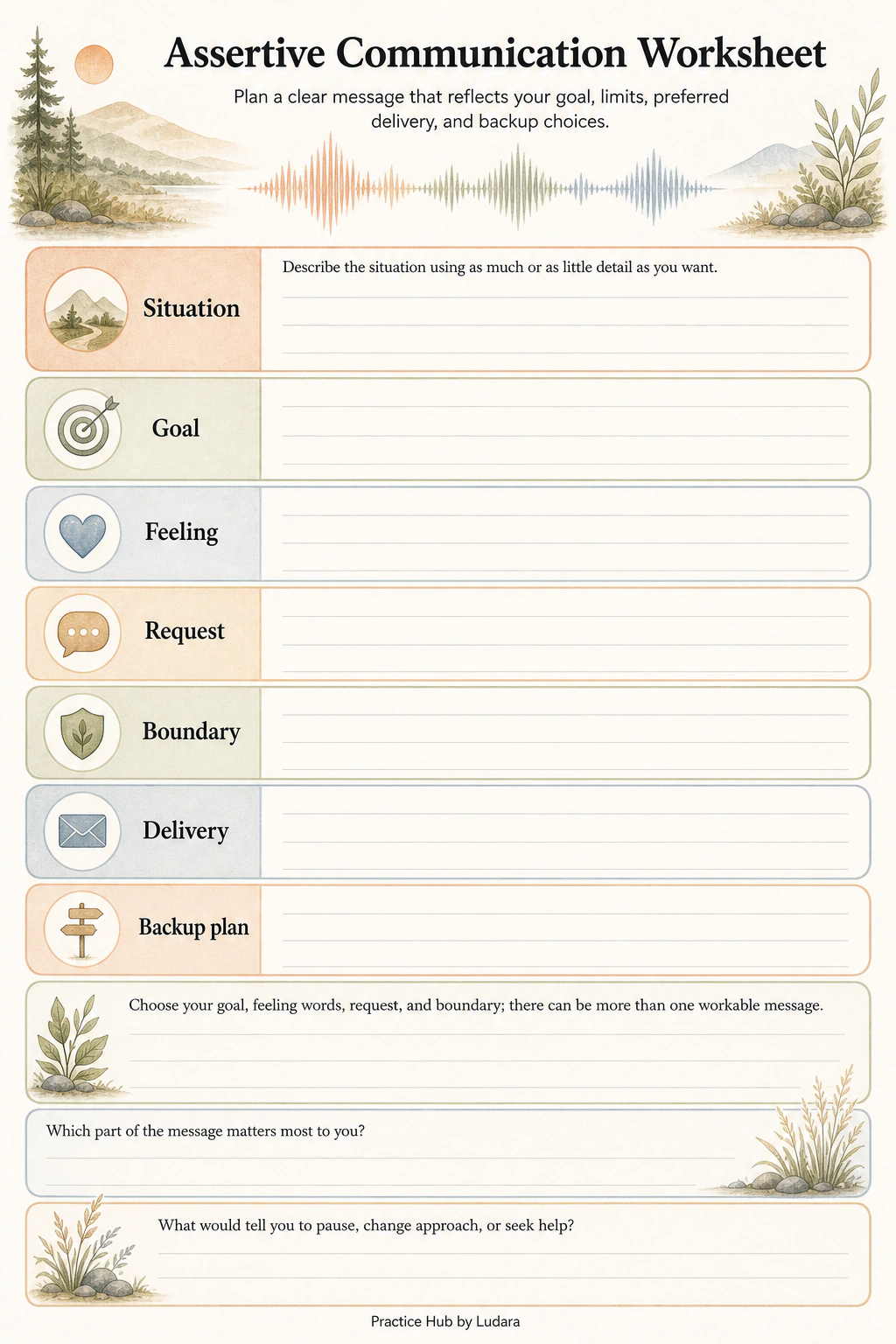
Assertive Communication Worksheet
Plan what you want to say, what you are asking for, how to deliver it, and what you could do if that approach does not fit.
For clinician-facilitated use
This is a professional resource, not a child-facing online service. A licensed clinician or other qualified adult must determine suitability, explain and adapt the activity, and supervise its use. Do not direct a child to access this webpage independently or enter client information.
An adult professional should download the full-resolution WebP, which includes margins for printing. Read the guidance below before using it.
How to use it
- Describe the situation using as much or as little detail as you want.
- Choose your goal, feeling words, request, and boundary; there can be more than one workable message.
- Pick a delivery option and a backup plan that fit the context.
- You may revise, pass, or seek support before using the message.

Questions to explore
- Which part of the message matters most to you?
- What would tell you to pause, change approach, or seek help?

Notes for the person facilitating
Treat passive, direct, indirect, and delayed responses as contextual strategies rather than moral categories. Help the participant distinguish a request from a limit and consider whether the recipient and setting are safe enough for direct communication.
Ways to adapt the activity
- Complete one section at a time or use sentence strips.
- Allow drawing, dictation, role-play, or AAC-supported composition.
- Use a fictional example before discussing a personal situation.
Professional use and fit
Before using this resource, a licensed clinician or other qualified adult should decide whether it fits the person, setting, goals, accessibility needs, and applicable local policies.