Social & Communication · SC-08
Conflict Navigation Paths
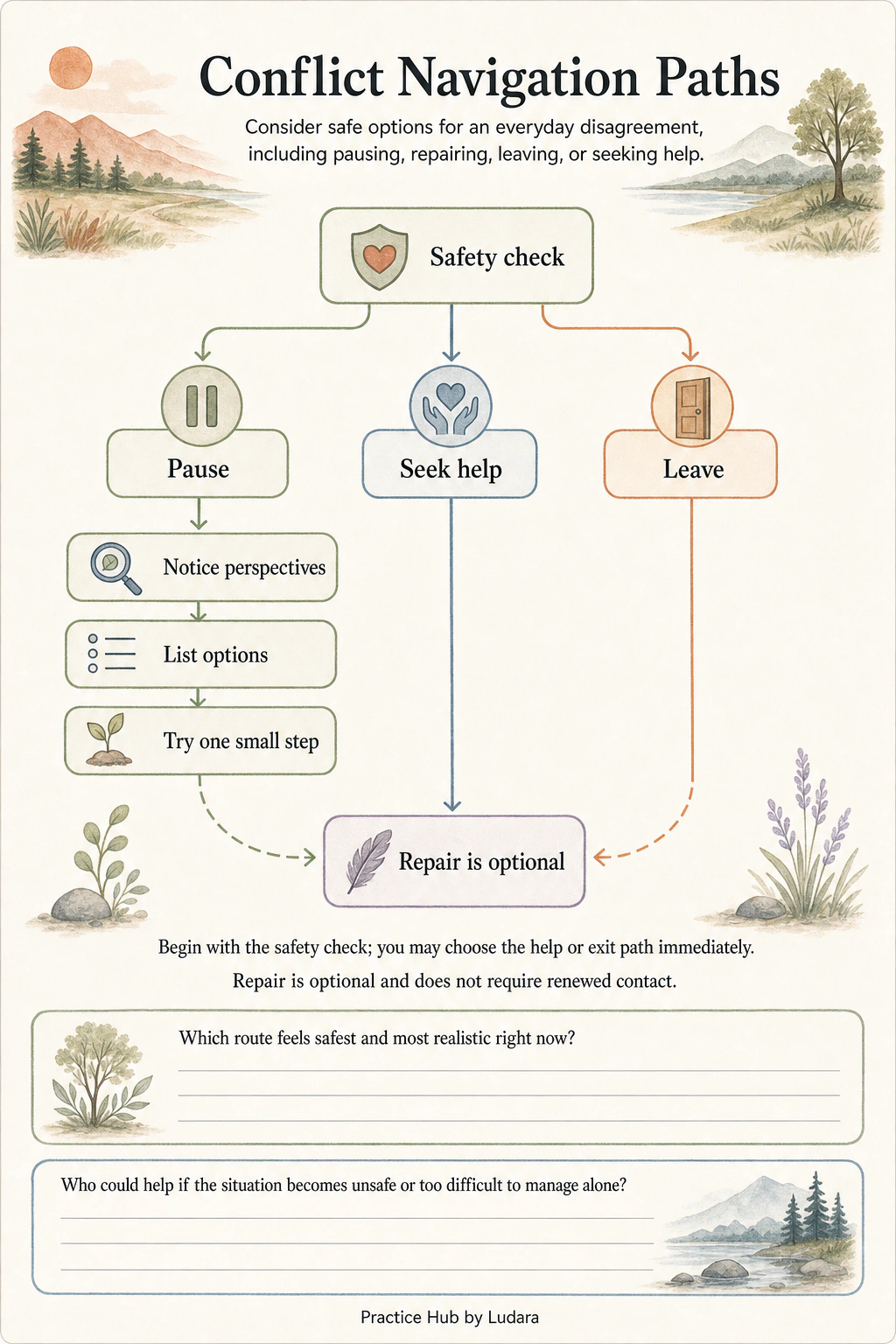
Consider safe options for an everyday disagreement, including pausing, repairing, leaving, or seeking help.
Clinician-created · specialist review requiredFor clinician-facilitated use
This is a professional resource, not a child-facing online service. A licensed clinician or other qualified adult must determine suitability, explain and adapt the activity, and supervise its use. Do not direct a child to access this webpage independently or enter client information.
The full-resolution WebP includes print-safe margins and should be downloaded by an adult professional. Read the guidance below before using the page.
How to use it
- Begin with the safety check; you may choose the help or exit path immediately.
- If mutual problem-solving seems safe, notice perspectives and list several options.
- Choose one small step to try, with permission to pause, return, or change routes.
- Repair is optional and does not require renewed contact.
Reflection prompts
- Which route feels safest and most realistic right now?
- Who could help if the situation becomes unsafe or too difficult to manage alone?

Facilitator guidance
Use only for ordinary conflicts after screening for fear, coercion, abuse, retaliation risk, and power imbalance. Do not frame mutual resolution, compromise, apology, or shared responsibility as appropriate when one person is unsafe.
Adaptations & accessibility
- Trace a fictional scenario before a personal one.
- Use removable route markers and a prominent help-path marker.
- Allow private completion, drawing, or supported communication.
Professional-use review
Enhanced licensed-specialist safeguarding review required before use. This activity is not appropriate as a mutual conflict-resolution tool in abuse, coercive control, exploitation, or serious power imbalance.