CBT-Informed Activities · CB-01
Thoughts, Feelings, and Actions
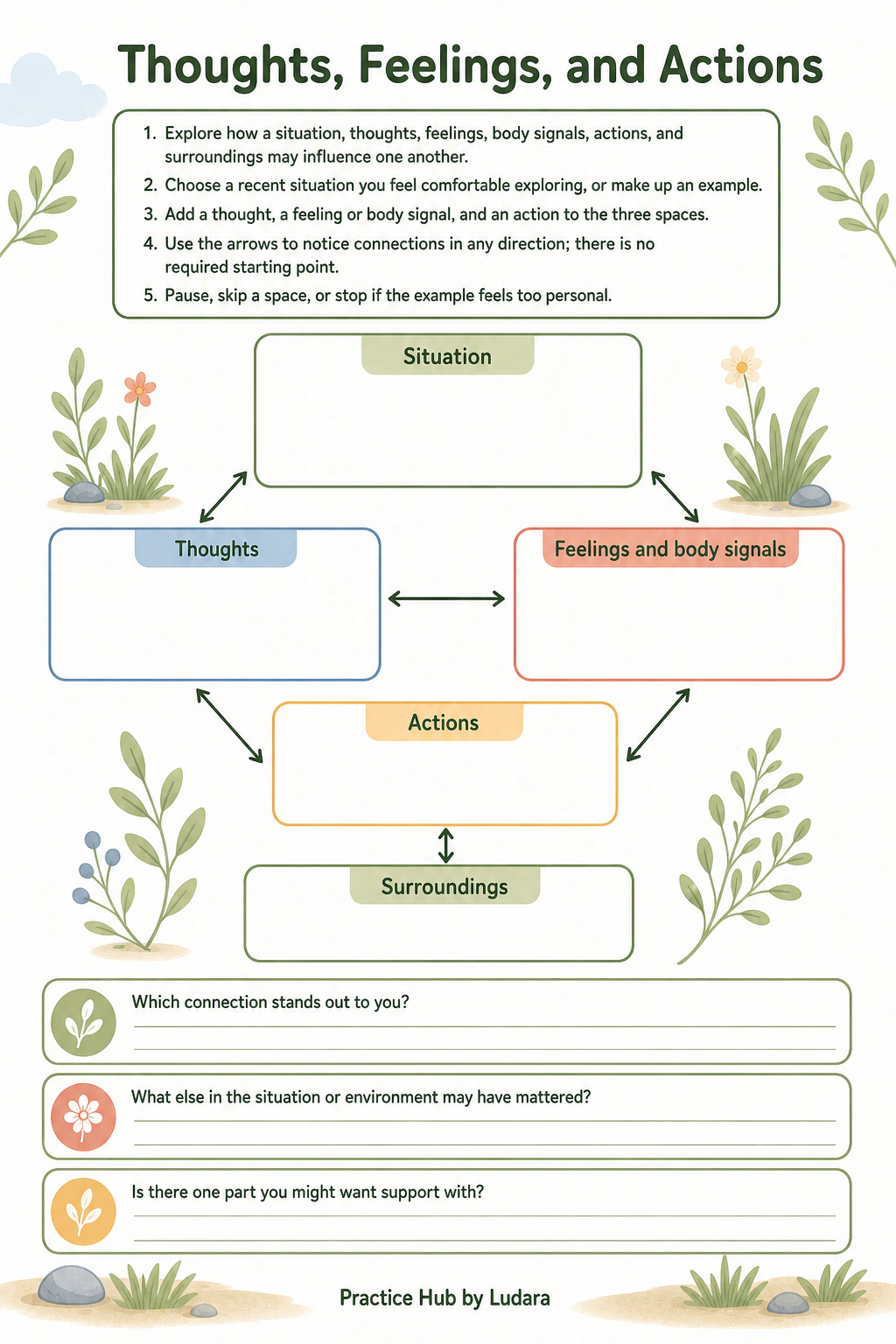
Map a situation and look at how thoughts, feelings, body signals, actions, and surroundings may connect.
For clinician-facilitated use
This is a professional resource, not a child-facing online service. A licensed clinician or other qualified adult must determine suitability, explain and adapt the activity, and supervise its use. Do not direct a child to access this webpage independently or enter client information.
An adult professional should download the full-resolution WebP, which includes margins for printing. Read the guidance below before using it.
How to use it
- Choose a recent situation you feel comfortable exploring, or make up an example.
- Add a thought, a feeling or body signal, and an action to the three spaces.
- Follow the arrows in either direction and see which connections you notice. You can start anywhere.
- Pause, skip a space, or stop if the example feels too personal.

Questions to explore
- Which connection stands out to you?
- What else in the situation or environment may have mattered?
- Is there one part you might want support with?

Notes for the person facilitating
Introduce this as a flexible map rather than a formula. Invite multiple possibilities, include body and environmental context, and avoid implying that thoughts alone caused the person's experience.
Ways to adapt the activity
- Draw or use symbols instead of writing.
- Complete the map aloud with a scribe or communication device.
- Use a fictional or low-intensity example before a personal one.
Professional use and fit
Before using this resource, a licensed clinician or other qualified adult should decide whether it fits the person, setting, goals, accessibility needs, and applicable local policies.