Couples & Family · CF-07
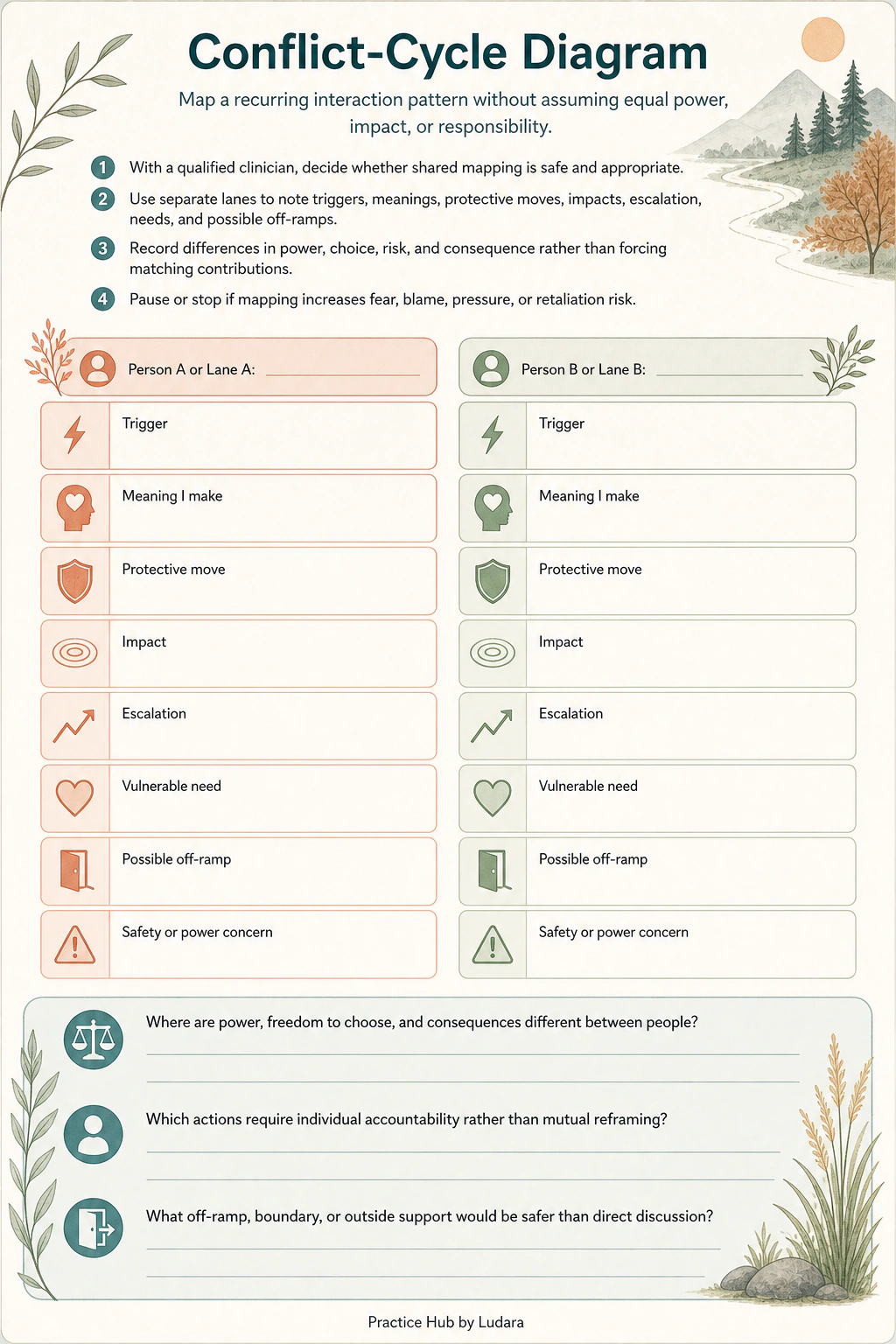
Conflict-Cycle Diagram
Map a recurring interaction pattern without assuming equal power, impact, or responsibility.
Clinician-created · specialist review requiredFor clinician-facilitated use
This is a professional resource, not a child-facing online service. A licensed clinician or other qualified adult must determine suitability, explain and adapt the activity, and supervise its use. Do not direct a child to access this webpage independently or enter client information.
The full-resolution WebP includes print-safe margins and should be downloaded by an adult professional. Read the guidance below before using the page.
How to use it
- With a qualified clinician, decide whether shared mapping is safe and appropriate.
- Use separate lanes to note triggers, meanings, protective moves, impacts, escalation, needs, and possible off-ramps.
- Record differences in power, choice, risk, and consequence rather than forcing matching contributions.
- Pause or stop if mapping increases fear, blame, pressure, or retaliation risk.
Reflection prompts
- Where are power, freedom to choose, and consequences different between people?
- Which actions require individual accountability rather than mutual reframing?
- What off-ramp, boundary, or outside support would be safer than direct discussion?

Facilitator guidance
Screen for abuse, coercive control, intimidation, and retaliation before joint mapping. Do not convert unilateral harm into a mutual cycle or use contextual understanding to dilute accountability.
Adaptations & accessibility
- Map each person's perspective separately and do not compare without explicit consent and safety assessment.
- Use color-independent lanes, icons, AAC, translation, or clinician scribing.
- Replace a circular diagram with a timeline when recurrence or symmetry would misrepresent events.
Professional-use review
Enhanced couples/family abuse-safety specialist and second licensed-clinician review required before use.