Couples & Family · CF-01
Relationship Check-In Cards
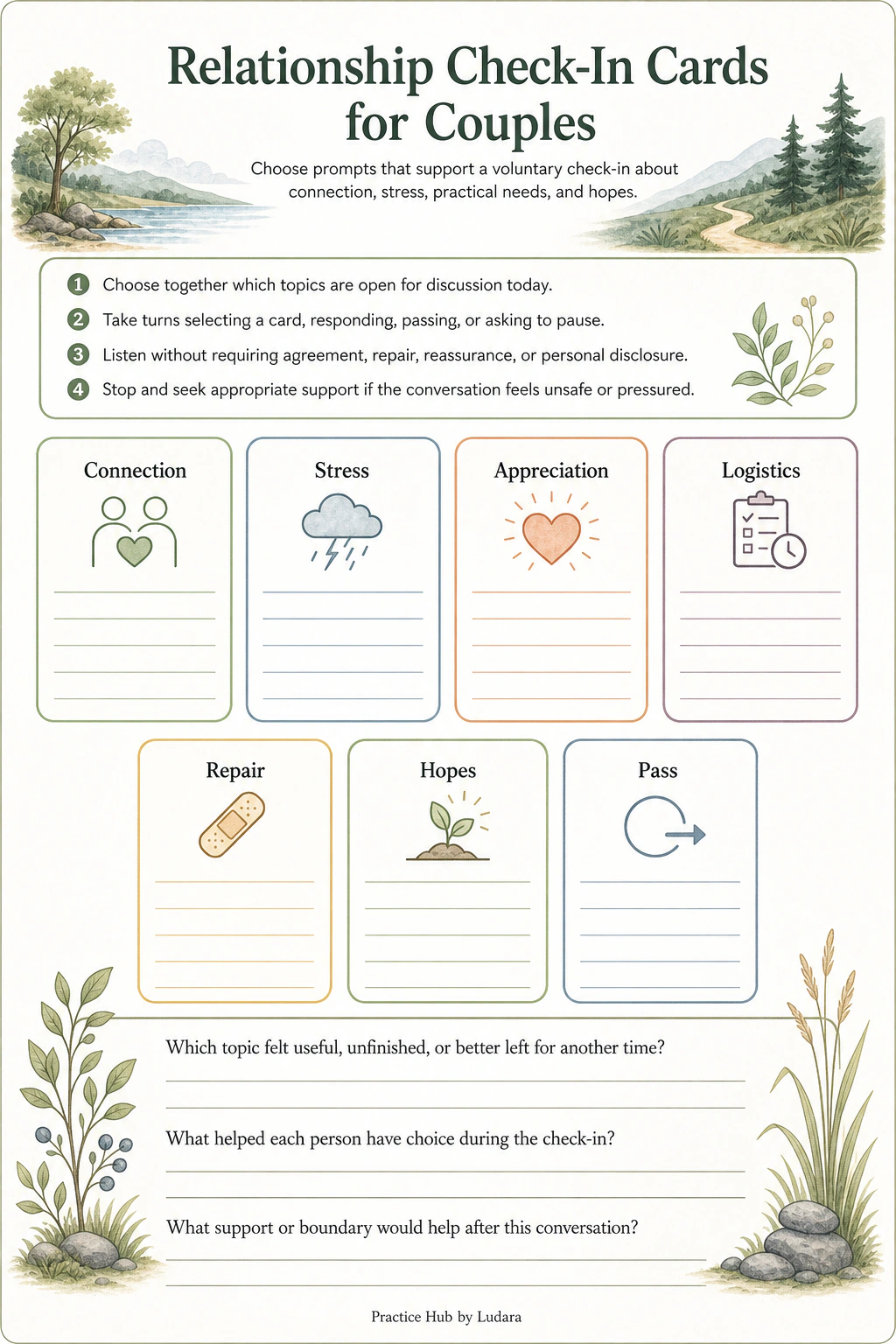
Choose a few cards for a voluntary conversation about connection, stress, everyday needs, or hopes.
For clinician-facilitated use
This is a professional resource, not a child-facing online service. A licensed clinician or other qualified adult must determine suitability, explain and adapt the activity, and supervise its use. Do not direct a child to access this webpage independently or enter client information.
An adult professional should download the full-resolution WebP, which includes margins for printing. Read the guidance below before using it.
How to use it
- Choose together which topics are open for discussion today.
- Take turns selecting a card, responding, passing, or asking to pause.
- Listen without requiring agreement, repair, reassurance, or personal disclosure.
- Stop and seek appropriate support if the conversation feels unsafe or pressured.

Questions to explore
- Which topic felt useful, unfinished, or better left for another time?
- What helped each person have choice during the check-in?
- What support or boundary would help after this conversation?

Notes for the person facilitating
Screen for coercive control, intimidation, retaliation risk, and other safety concerns before shared use. These cards are not appropriate for unsupervised couple dialogue when speaking honestly or passing may carry risk; individual or specialist support may be safer.
Ways to adapt the activity
- Use one preselected low-intensity card with a time limit and separate pass cards.
- Offer written, AAC, translated, or individual-response formats without requiring responses to be shared.
- Separate the deck into logistics, connection, stress, hopes, and repair so participants can exclude topics.
Professional use and fit
Before using this resource, a licensed clinician or other qualified adult should decide whether it fits the person, setting, goals, accessibility needs, and applicable local policies.