Couples & Family · CF-02
Needs and Care Preferences
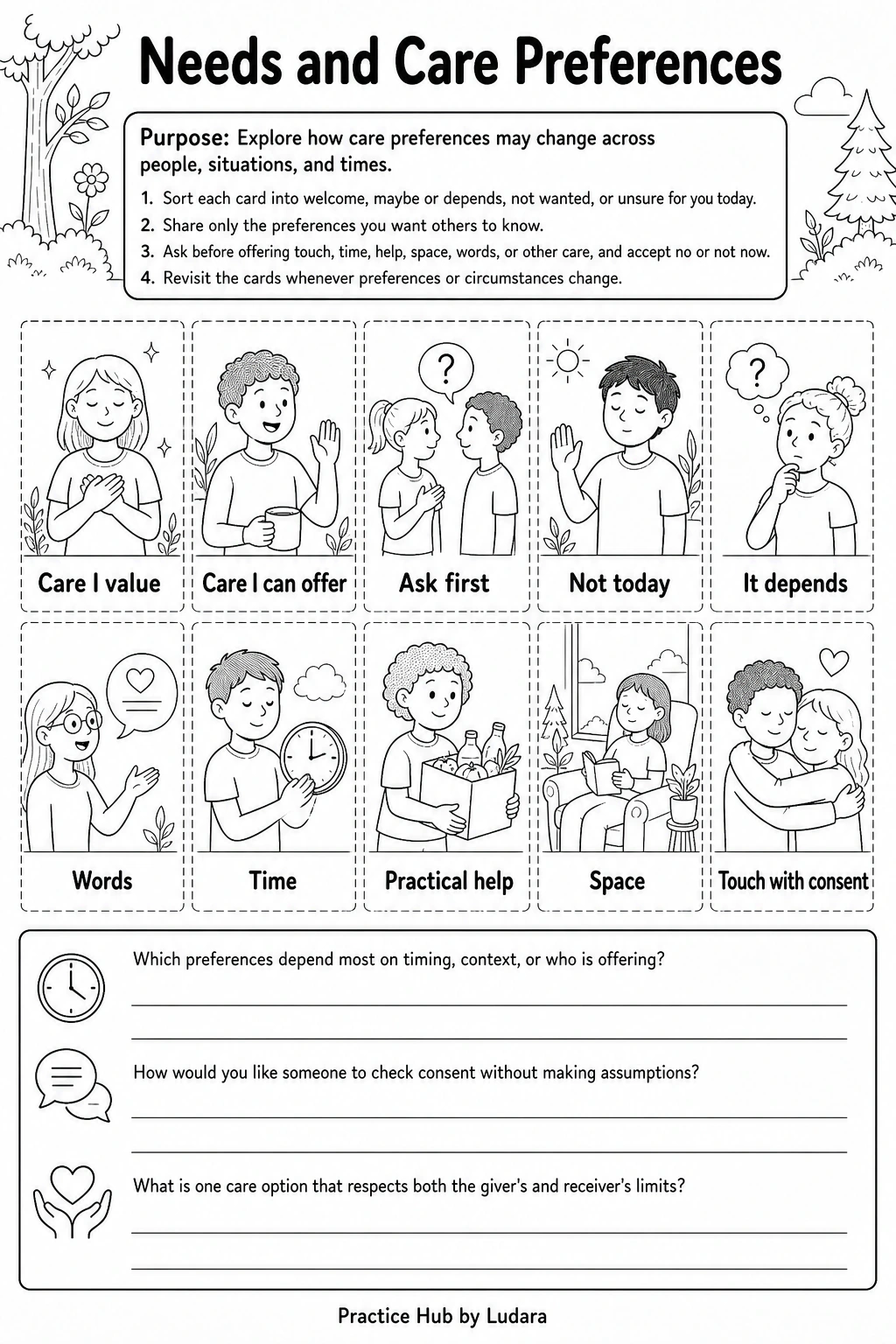
Talk about what kinds of care feel welcome today, knowing that preferences can change with the person and situation.
For clinician-facilitated use
This is a professional resource, not a child-facing online service. A licensed clinician or other qualified adult must determine suitability, explain and adapt the activity, and supervise its use. Do not direct a child to access this webpage independently or enter client information.
An adult professional should download the full-resolution WebP, which includes margins for printing. Read the guidance below before using it.
How to use it
- Sort each card into welcome, maybe or depends, not wanted, or unsure for you today.
- Share only the preferences you want others to know.
- Ask before offering touch, time, help, space, words, or other care, and accept no or not now.
- Revisit the cards whenever preferences or circumstances change.

Questions to explore
- Which preferences depend most on timing, context, or who is offering?
- How would you like someone to check consent without making assumptions?
- What is one care option that respects both the giver's and receiver's limits?

Notes for the person facilitating
Present preferences as contextual and changeable rather than fixed types. Consent is required for touch and every other form of care; declining an offer must not invite punishment, pressure, or scorekeeping.
Ways to adapt the activity
- Sort cards privately before choosing whether to compare responses.
- Use photos, icons, translation, AAC, or concrete examples relevant to the household.
- Remove touch cards or any category that is uncomfortable or unsafe to discuss.
Professional use and fit
Before using this resource, a licensed clinician or other qualified adult should decide whether it fits the person, setting, goals, accessibility needs, and applicable local policies.