Couples & Family · CF-04
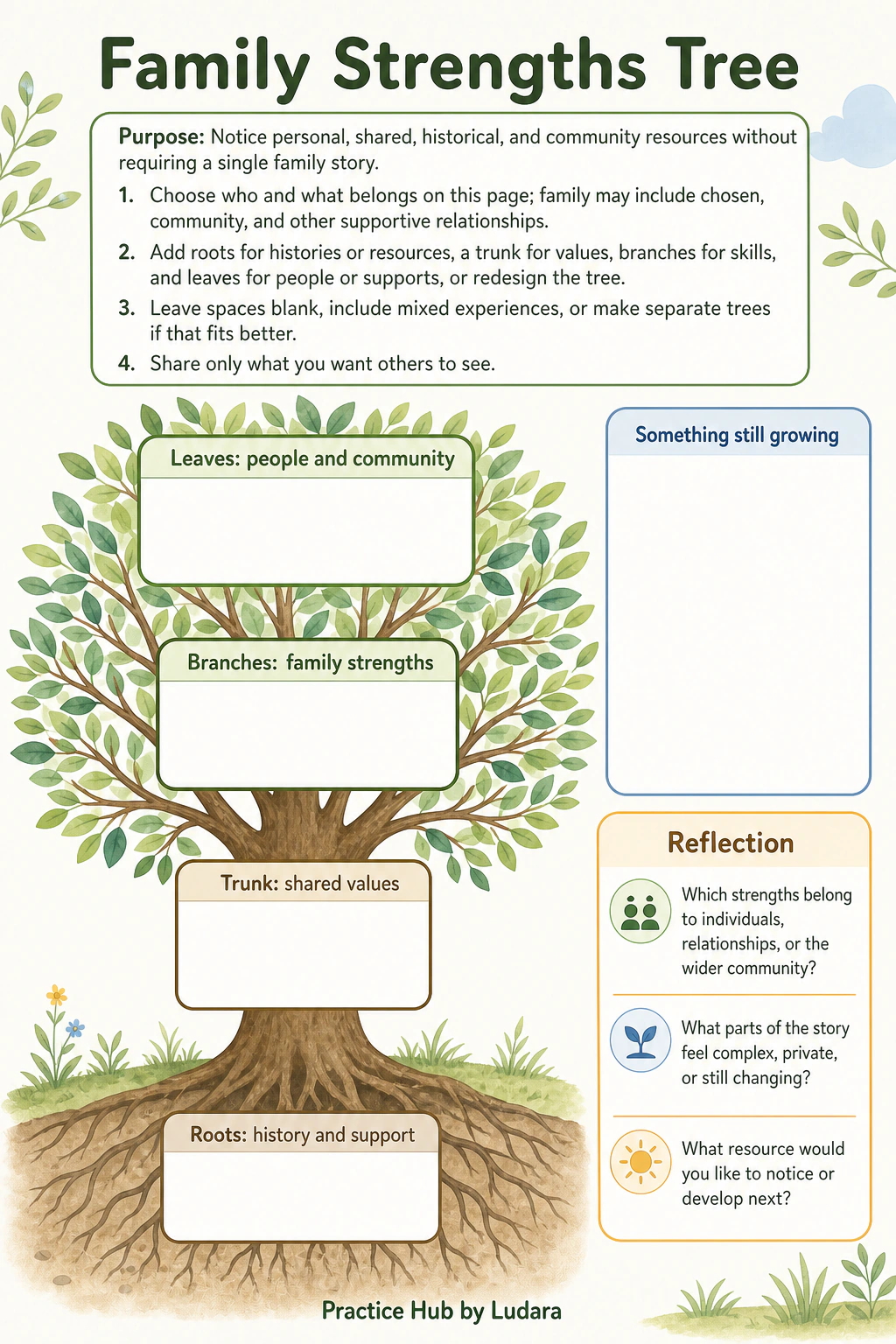
Family Strengths Tree
Build a picture of personal, family, historical, and community strengths. Different people can tell different stories.
For clinician-facilitated use
This is a professional resource, not a child-facing online service. A licensed clinician or other qualified adult must determine suitability, explain and adapt the activity, and supervise its use. Do not direct a child to access this webpage independently or enter client information.
An adult professional should download the full-resolution WebP, which includes margins for printing. Read the guidance below before using it.
How to use it
- Choose who and what belongs on this page; family may include chosen, community, and other supportive relationships.
- Add roots for histories or resources, a trunk for values, branches for skills, and leaves for people or supports, or redesign the tree.
- Leave gaps, include mixed experiences, or make separate trees if one shared tree does not fit.
- Share only what you want others to see.

Questions to explore
- Which strengths belong to individuals, relationships, or the wider community?
- What parts of the story feel complex, private, or still changing?
- What resource would you like to notice or develop next?

Notes for the person facilitating
Invite multiple perspectives and avoid forcing unity, gratitude, resilience, or a positive family narrative. Do not treat absence from the tree as proof of conflict or lack of care.
Ways to adapt the activity
- Use a garden, constellation, house, network, or separate pages instead of a tree.
- Offer household, chosen-family, cultural, community, and professional-support tokens.
- Build the page with removable notes, photos, drawing, dictation, or AAC.
Professional use and fit
Before using this resource, a licensed clinician or other qualified adult should decide whether it fits the person, setting, goals, accessibility needs, and applicable local policies.