Teen-Focused Resources · TE-07
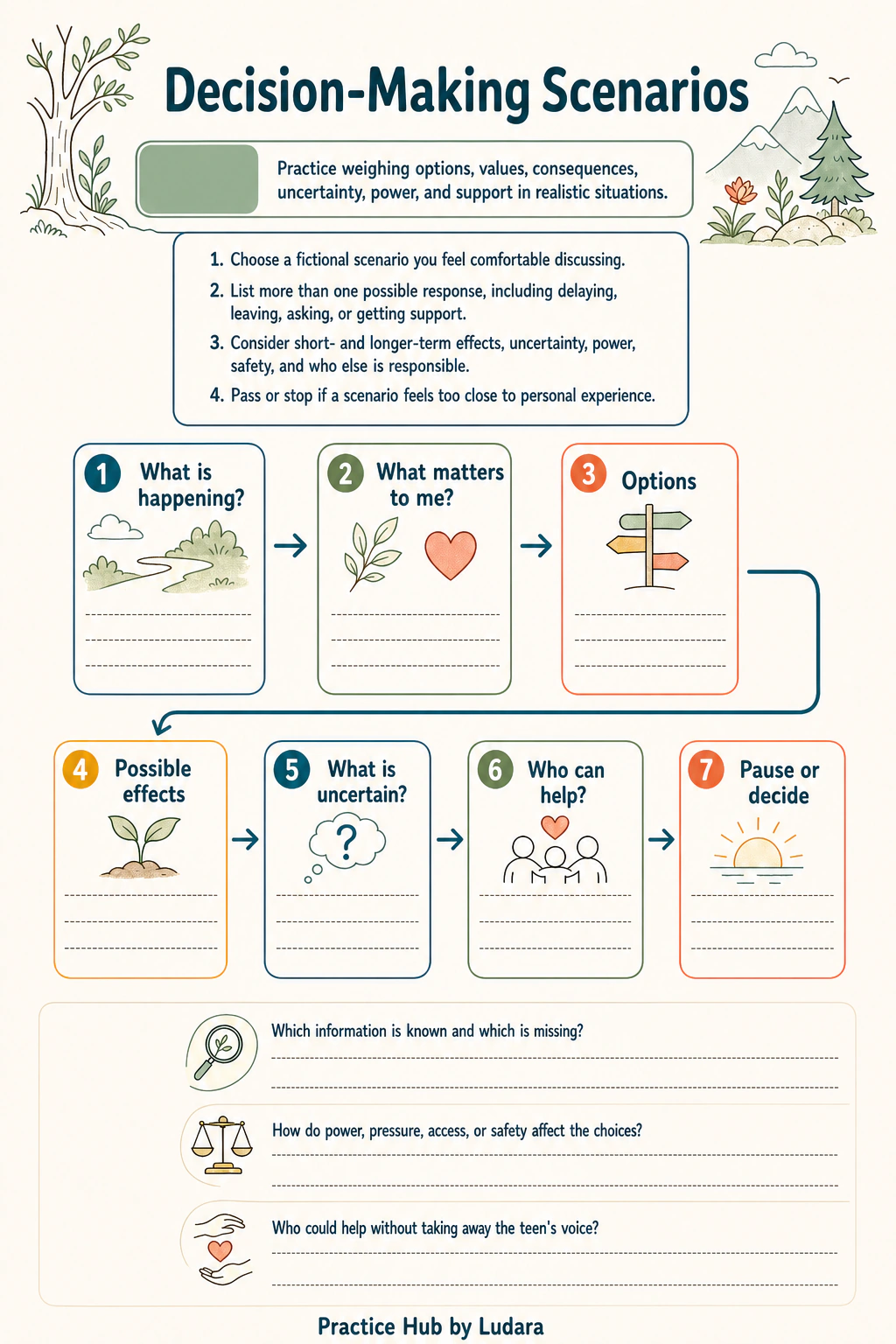
Decision-Making Scenarios
Work through a fictional situation by weighing choices, values, consequences, uncertainty, power, and available support.
For clinician-facilitated use
This is a professional resource, not a child-facing online service. A licensed clinician or other qualified adult must determine suitability, explain and adapt the activity, and supervise its use. Do not direct a child to access this webpage independently or enter client information.
An adult professional should download the full-resolution WebP, which includes margins for printing. Read the guidance below before using it.
How to use it
- Choose a fictional scenario you feel comfortable discussing.
- List more than one possible response, including delaying, leaving, asking, or getting support.
- Consider short- and longer-term effects, uncertainty, power, safety, and who else is responsible.
- Pass or stop if a scenario feels too close to personal experience.

Questions to explore
- Which information is known and which is missing?
- How do power, pressure, access, or safety affect the choices?
- Who could help without taking away the teen's voice?

Notes for the person facilitating
Do not present one universal correct answer where context varies. Use appropriate safeguarding judgment for scenarios involving substances, sex, violence, exploitation, self-harm, health, or illegal activity; never use the activity to rehearse concealment.
Ways to adapt the activity
- Offer two low-intensity options before open brainstorming.
- Use visual consequence maps or role-neutral characters.
- Let the teen create or reject scenarios.
Professional use and fit
Before using this resource, a licensed clinician or other qualified adult should decide whether it fits the person, setting, goals, accessibility needs, and applicable local policies.