Teen-Focused Resources · TE-02
My Social Media Boundaries
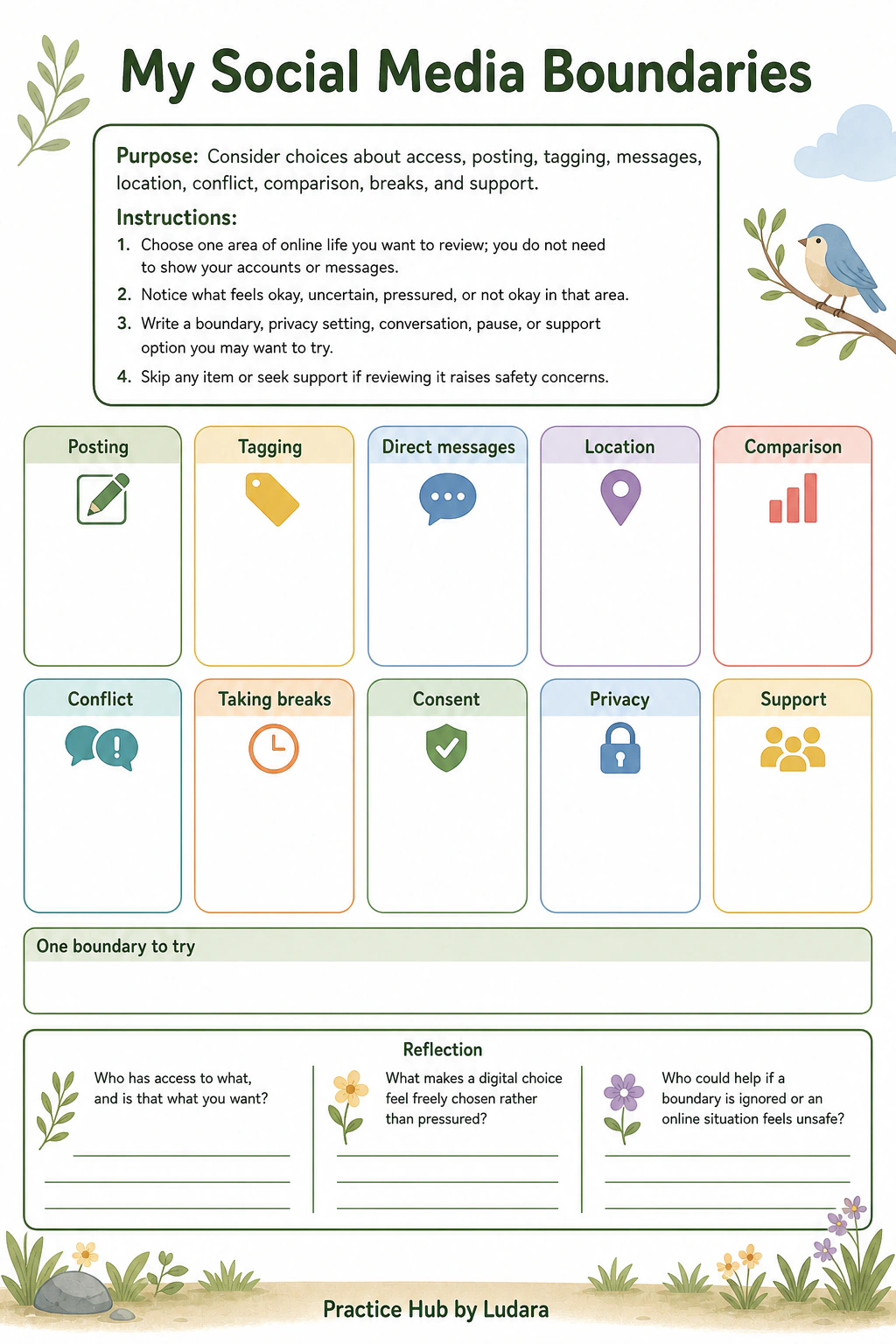
Look at the parts of online life you want more say over, from messages and tags to location sharing, breaks, and support.
For clinician-facilitated use
This is a professional resource, not a child-facing online service. A licensed clinician or other qualified adult must determine suitability, explain and adapt the activity, and supervise its use. Do not direct a child to access this webpage independently or enter client information.
An adult professional should download the full-resolution WebP, which includes margins for printing. Read the guidance below before using it.
How to use it
- Choose one area of online life you want to review; you do not need to show your accounts or messages.
- Notice what feels okay, uncertain, pressured, or not okay in that area.
- Write a boundary, privacy setting, conversation, pause, or support option you may want to try.
- Skip any item or seek support if reviewing it raises safety concerns.

Questions to explore
- Who has access to what, and is that what you want?
- What makes a digital choice feel freely chosen rather than pressured?
- Who could help if a boundary is ignored or an online situation feels unsafe?

Notes for the person facilitating
Protect the teen's privacy and avoid requiring account access, message review, or surveillance. Discuss consent, coercion, platform settings, documentation, and help-seeking in developmentally and contextually appropriate ways.
Ways to adapt the activity
- Use fictional scenarios instead of personal accounts.
- Review one feature or platform behavior at a time.
- Offer a paper, verbal, or device-accessible version without screenshots.
Professional use and fit
Before using this resource, a licensed clinician or other qualified adult should decide whether it fits the person, setting, goals, accessibility needs, and applicable local policies.