Couples & Family · CF-08
Appreciation Cards
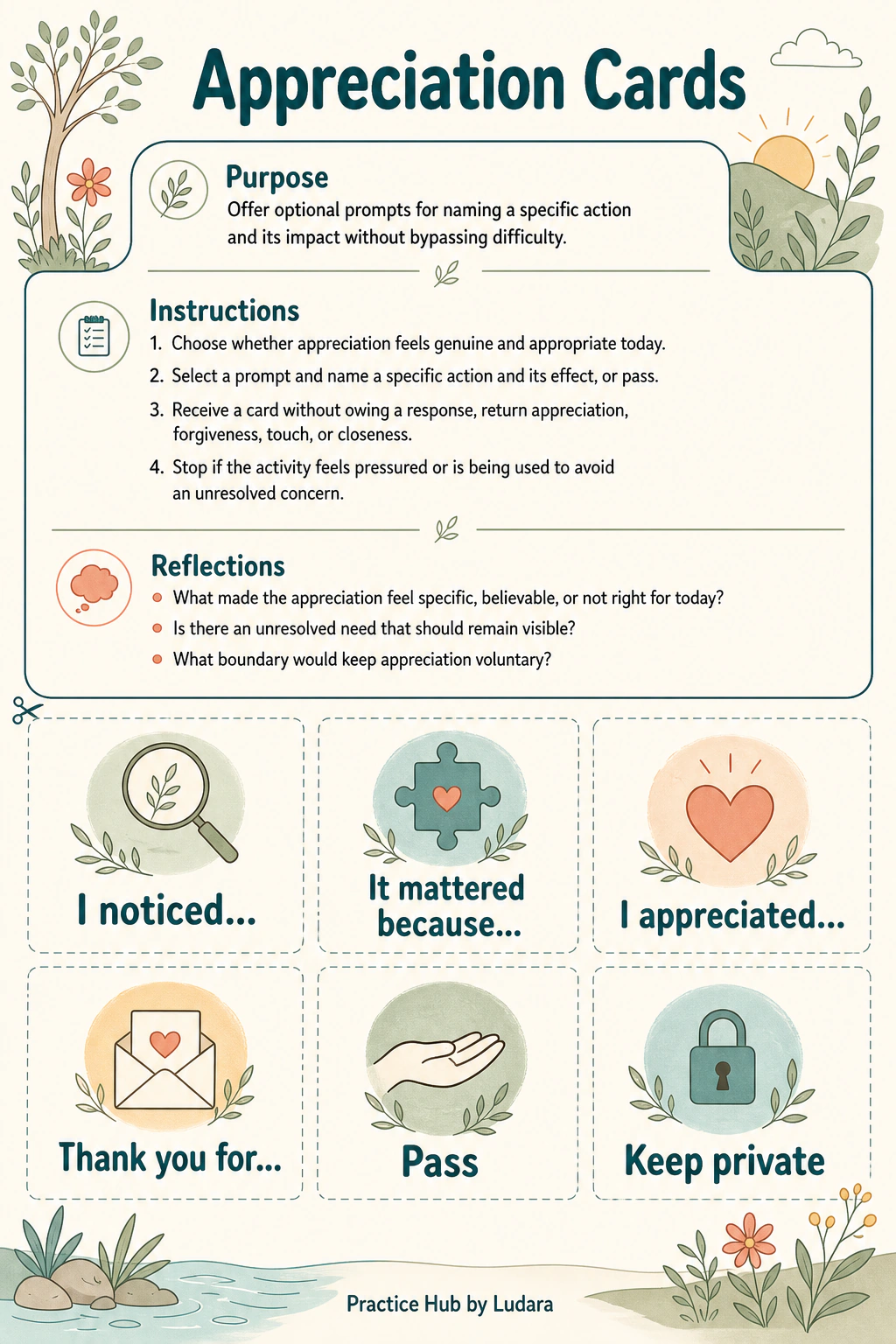
Name an action you appreciate and what it meant to you, if that feels right today. Difficulties do not need to be set aside.
For clinician-facilitated use
This is a professional resource, not a child-facing online service. A licensed clinician or other qualified adult must determine suitability, explain and adapt the activity, and supervise its use. Do not direct a child to access this webpage independently or enter client information.
An adult professional should download the full-resolution WebP, which includes margins for printing. Read the guidance below before using it.
How to use it
- Choose whether appreciation feels genuine and appropriate today.
- Select a prompt and name a specific action and its effect, or pass.
- Receive a card without owing a response, return appreciation, forgiveness, touch, or closeness.
- Stop if the activity feels pressured or is being used to avoid an unresolved concern.

Questions to explore
- What made the appreciation feel specific, believable, or not right for today?
- Is there an unresolved need that should remain visible?
- What boundary would keep appreciation voluntary?

Notes for the person facilitating
Do not prescribe appreciation during active harm, acute conflict, coercion, or before accountability and safety needs are addressed. Appreciation must never become a condition for care, repair, or participation.
Ways to adapt the activity
- Allow private writing that is not delivered.
- Offer action-and-impact icons, sentence stems, translation, AAC, or a spoken format.
- Use an observation card without positive evaluation when appreciation does not fit.
Professional use and fit
Before using this resource, a licensed clinician or other qualified adult should decide whether it fits the person, setting, goals, accessibility needs, and applicable local policies.