Play Therapy · PT-06
Feelings Journey Mazes
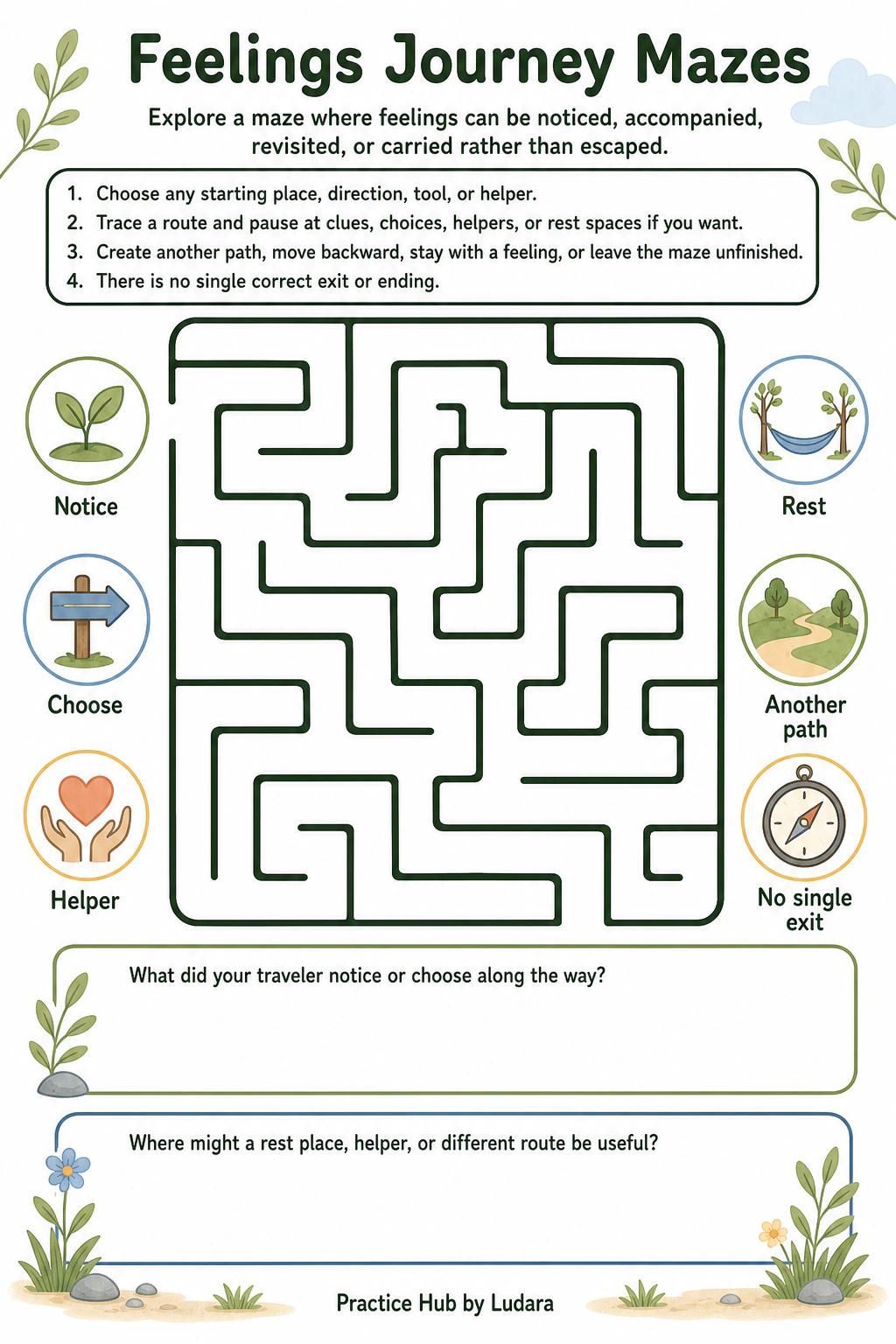
Explore a maze where feelings can be noticed, accompanied, revisited, or carried rather than escaped.
Clinician-created · facilitator review requiredFor clinician-facilitated use
This is a professional resource, not a child-facing online service. A licensed clinician or other qualified adult must determine suitability, explain and adapt the activity, and supervise its use. Do not direct a child to access this webpage independently or enter client information.
The full-resolution WebP includes print-safe margins and should be downloaded by an adult professional. Read the guidance below before using the page.
How to use it
- Choose any starting place, direction, tool, or helper.
- Trace a route and pause at clues, choices, helpers, or rest spaces if you want.
- Create another path, move backward, stay with a feeling, or leave the maze unfinished.
- There is no single correct exit or ending.

Reflection prompts
- What did your traveler notice or choose along the way?
- Where might a rest place, helper, or different route be useful?

Facilitator guidance
Frame the maze as a journey with multiple routes, not a task to eliminate an emotion. Avoid speed scoring, emotional hierarchies, or interpretations of route choice; reinforce agency, curiosity, and the option not to complete.
Adaptations & accessibility
- Use finger tracing, eye-gaze, verbal direction, movable tokens, or a larger maze.
- Reduce visual complexity or add high-contrast tactile paths.
- Let the child design a maze with loops, rests, and no exit.
Professional-use review
Licensed play-therapy and accessibility review required before use; feelings must not be framed as problems to escape, and completion, speed, or the selected route must not be treated as a clinical measure.