Play Therapy · PT-01
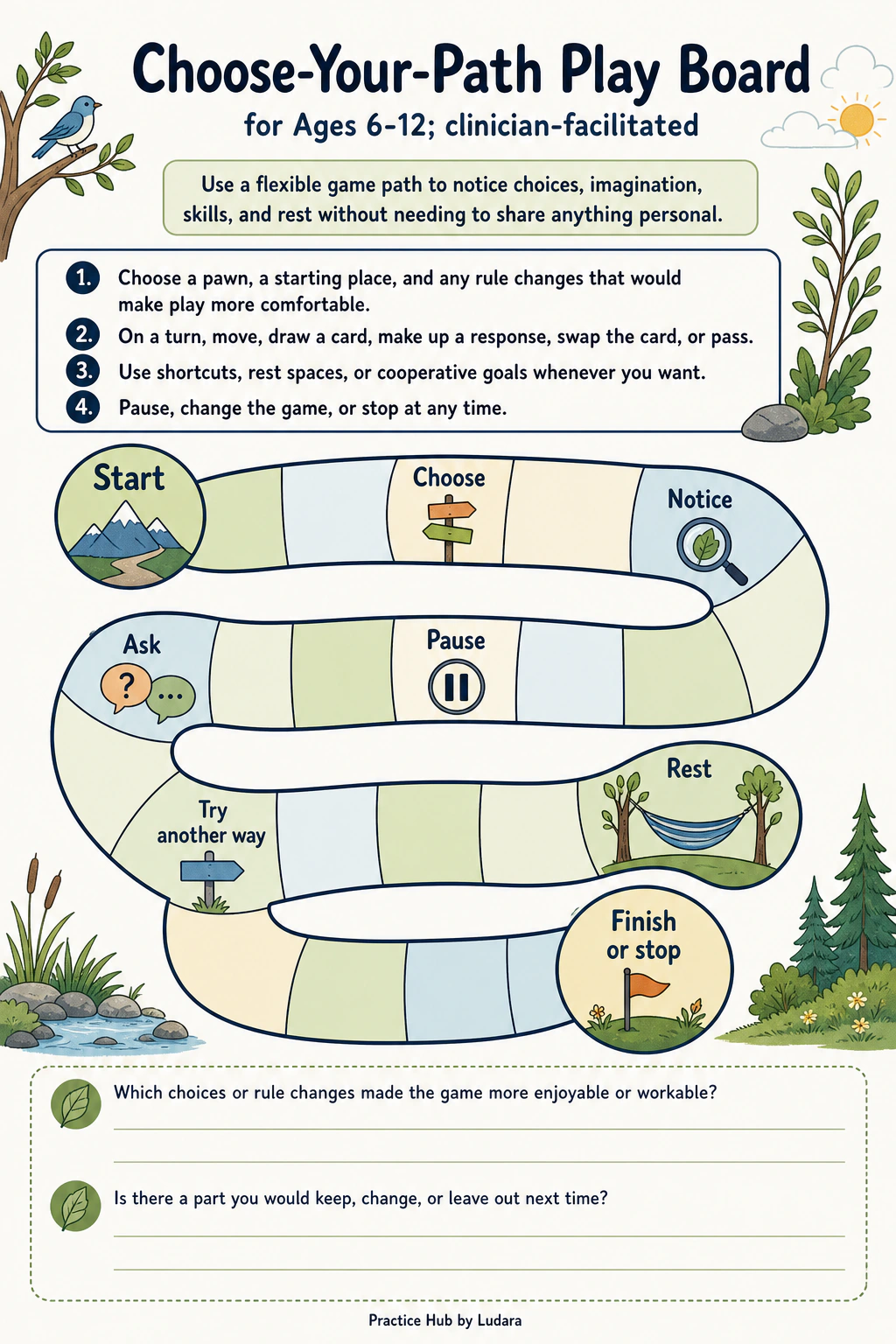
Choose-Your-Path Play Board
Use a flexible game path to notice choices, imagination, skills, and rest without needing to share anything personal.
Clinician-created · facilitator review requiredFor clinician-facilitated use
This is a professional resource, not a child-facing online service. A licensed clinician or other qualified adult must determine suitability, explain and adapt the activity, and supervise its use. Do not direct a child to access this webpage independently or enter client information.
The full-resolution WebP includes print-safe margins and should be downloaded by an adult professional. Read the guidance below before using the page.
How to use it
- Choose a pawn, a starting place, and any rule changes that would make play more comfortable.
- On a turn, move, draw a card, make up a response, swap the card, or pass.
- Use shortcuts, rest spaces, or cooperative goals whenever you want.
- Pause, change the game, or stop at any time.

Reflection prompts
- Which choices or rule changes made the game more enjoyable or workable?
- Is there a part you would keep, change, or leave out next time?

Facilitator guidance
Agree on rules collaboratively and offer imaginative, neutral, and skill-based card sets alongside blank cards. Do not award progress for disclosure, emotional performance, compliance, or a preferred answer; model rule revision and preserve the child's control over personal content.
Adaptations & accessibility
- Play cooperatively against a timer-free shared challenge or remove winning entirely.
- Use a spinner, choice cards, eye-gaze, AAC, or direct pawn placement instead of dice.
- Shorten the path and add sensory, movement, or rest breaks.
Professional-use review
Licensed play-therapy review required before use; verify voluntary participation, developmental fit, motor and sensory access, and that no rule rewards disclosure, compliance, competition, or symptom absence.