Play Therapy · PT-03
Puppets and Character Cutouts
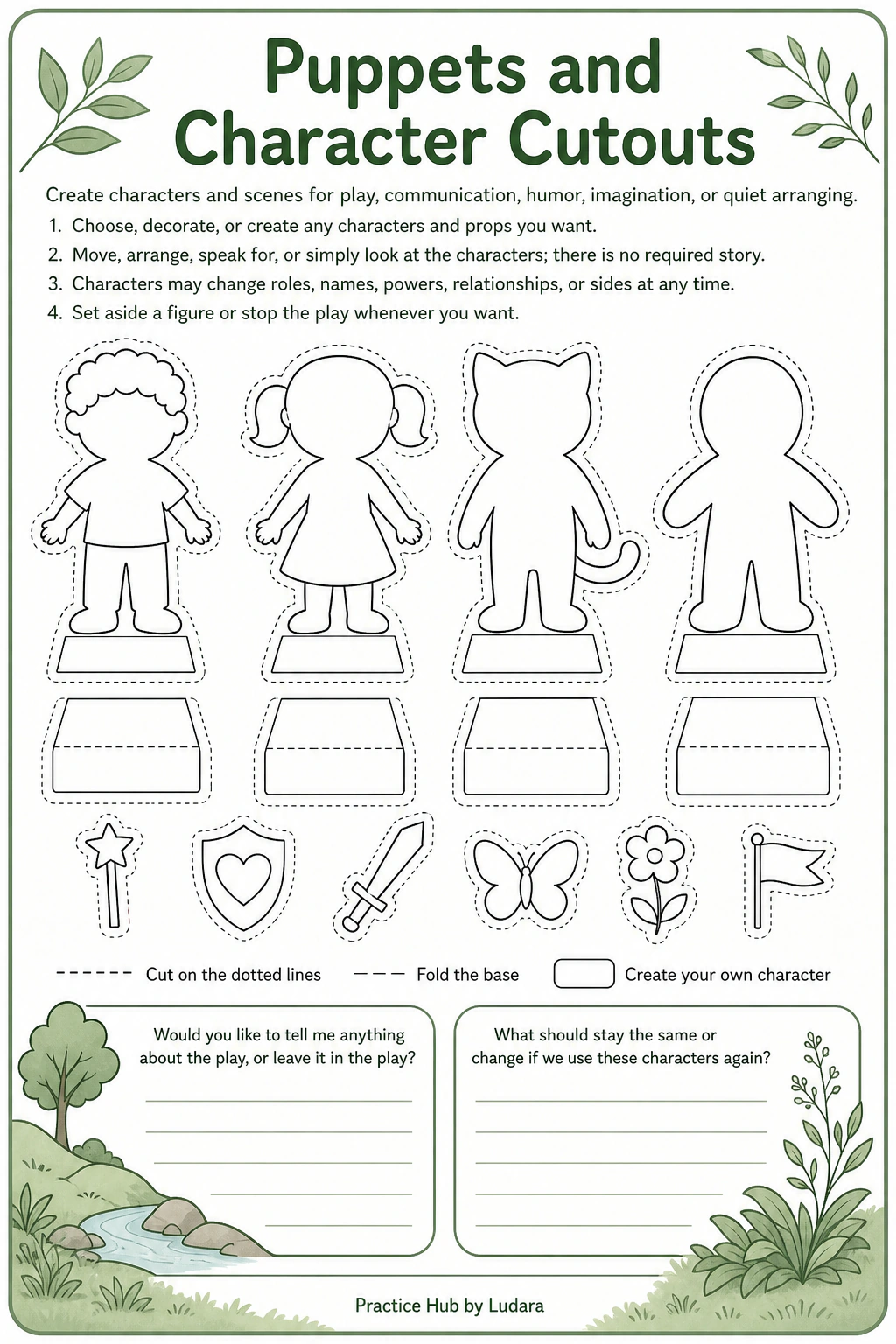
Make characters for stories, jokes, imaginative scenes, communication, or simply moving the pieces around.
For clinician-facilitated use
This is a professional resource, not a child-facing online service. A licensed clinician or other qualified adult must determine suitability, explain and adapt the activity, and supervise its use. Do not direct a child to access this webpage independently or enter client information.
An adult professional should download the full-resolution WebP, which includes margins for printing. Read the guidance below before using it.
How to use it
- Choose, decorate, or create any characters and props you want.
- Move, arrange, speak for, or simply look at the characters; there is no required story.
- Change the characters as you go: their names, roles, powers, relationships, or sides in the story.
- Set aside a figure or stop the play whenever you want.

Questions to explore
- Would you like to tell me anything about the play, or leave it in the play?
- What should stay the same or change if we use these characters again?

Notes for the person facilitating
Maintain a nondirective stance unless structure is clinically indicated and consented to. Avoid fixed villain, victim, rescuer, family, or diagnostic roles, and do not infer lived events from enactment alone; use ordinary safeguarding assessment when concerns arise.
Ways to adapt the activity
- Use preassembled figures, magnetic pieces, larger handles, or tabletop stands.
- Offer blank, nonhuman, fantasy, mobility-aid, and ambiguous-role figures.
- Permit parallel play, silent arranging, or clinician-assisted movement.
Professional use and fit
Before using this resource, a licensed clinician or other qualified adult should decide whether it fits the person, setting, goals, accessibility needs, and applicable local policies.