Social & Communication · SC-09
Listening Skills Games
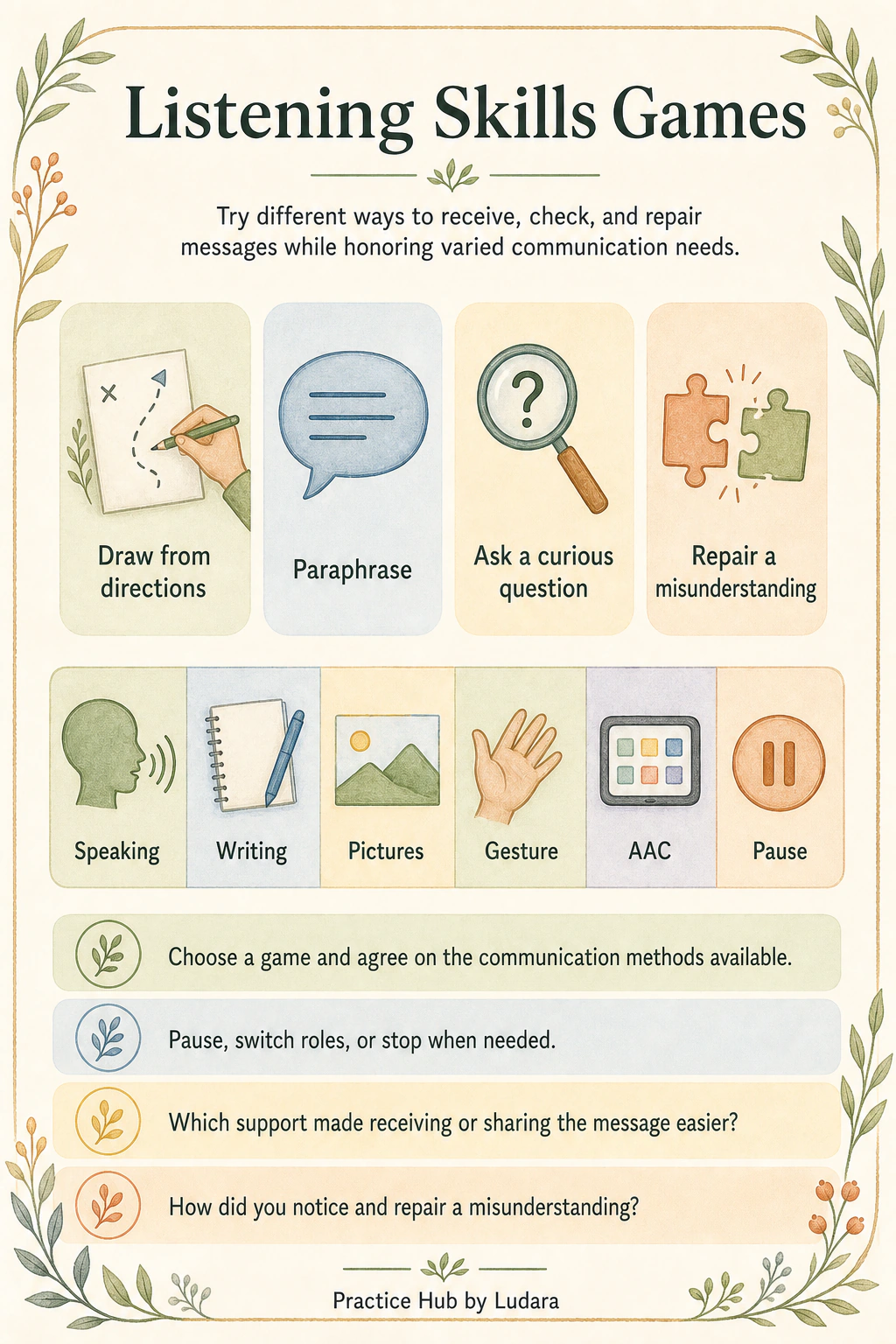
Try different ways to receive, check, and repair messages while honoring varied communication needs.
Clinician-created · facilitator review requiredFor clinician-facilitated use
This is a professional resource, not a child-facing online service. A licensed clinician or other qualified adult must determine suitability, explain and adapt the activity, and supervise its use. Do not direct a child to access this webpage independently or enter client information.
The full-resolution WebP includes print-safe margins and should be downloaded by an adult professional. Read the guidance below before using the page.
How to use it
- Choose a game and agree on the communication methods available.
- Try the task using speaking, writing, pictures, gesture, AAC, or a combination.
- Use a clarification or repair option whenever the message is unclear.
- Pause, switch roles, or stop when needed.

Reflection prompts
- Which support made receiving or sharing the message easier?
- How did you notice and repair a misunderstanding?

Facilitator guidance
Define listening broadly as receiving and checking meaning, not eye contact, stillness, rapid response, or speech alone. Adjust pace, sensory load, language complexity, and memory demands without treating accommodations as cheating.
Adaptations & accessibility
- Provide visual directions and extra processing time.
- Use headphones, reduced noise, movement breaks, or one-to-one play.
- Permit AAC, signing, writing, drawing, or a communication partner.
Professional-use review
Licensed-clinician and communication-access review required before use; verify that scoring does not penalize disability-related communication differences.