Couples & Family · CF-09
Shared Goals Worksheet
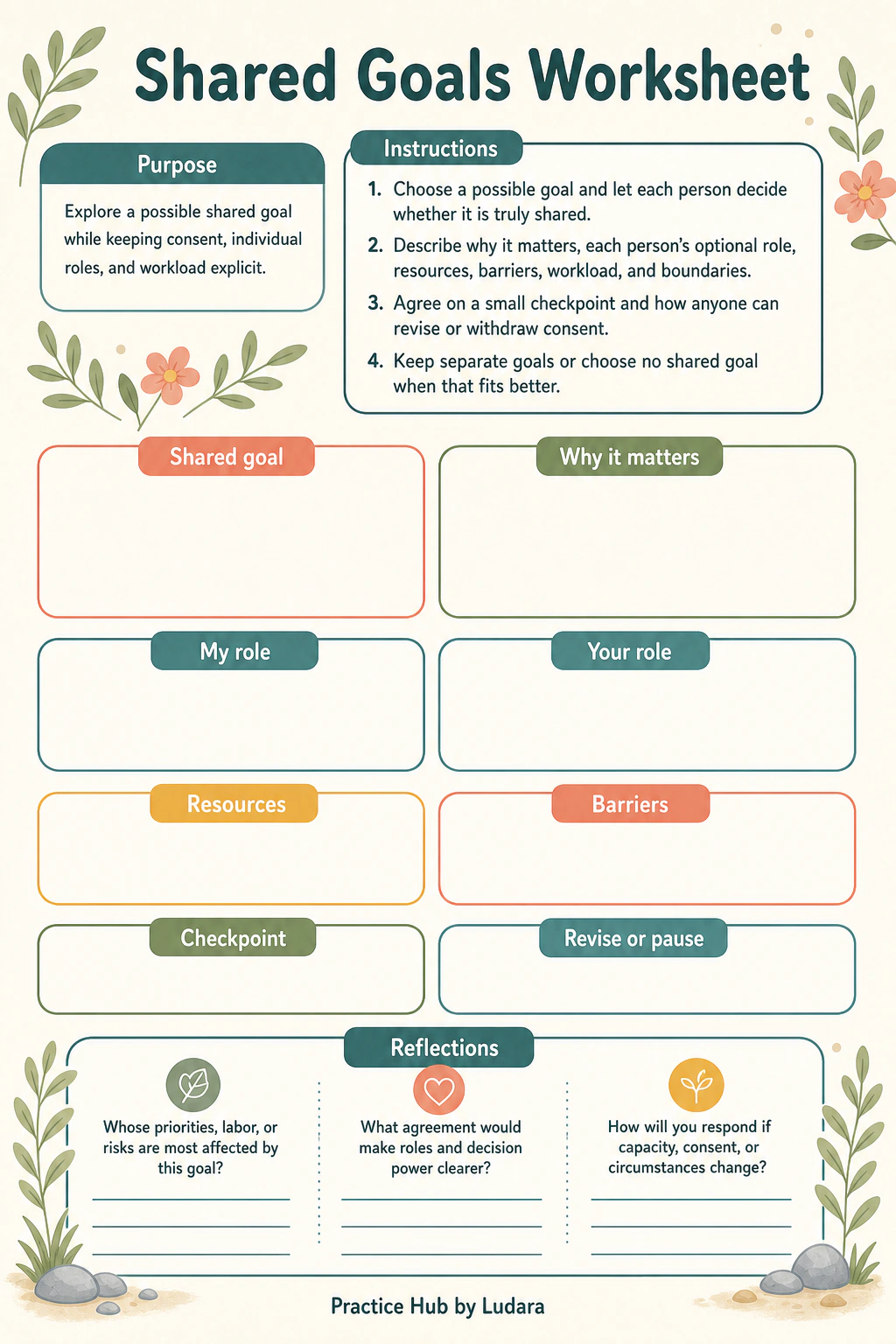
Consider a goal together and work out whether it is truly shared, who would do what, and what each person can agree to.
For clinician-facilitated use
This is a professional resource, not a child-facing online service. A licensed clinician or other qualified adult must determine suitability, explain and adapt the activity, and supervise its use. Do not direct a child to access this webpage independently or enter client information.
An adult professional should download the full-resolution WebP, which includes margins for printing. Read the guidance below before using it.
How to use it
- Choose a possible goal and let each person decide whether it is truly shared.
- Describe why it matters, each person's optional role, resources, barriers, workload, and boundaries.
- Agree on a small checkpoint and how anyone can revise or withdraw consent.
- Keep separate goals or choose no shared goal when that fits better.

Questions to explore
- Whose priorities, labor, or risks are most affected by this goal?
- What agreement would make roles and decision power clearer?
- How will you respond if capacity, consent, or circumstances change?

Notes for the person facilitating
Check that agreement is freely given and that invisible, emotional, financial, and logistical labor are considered. Do not frame reluctance, limited capacity, or a separate goal as lack of commitment.
Ways to adapt the activity
- Use individual lanes before a shared section.
- Break the plan into visual tasks with owner, support, time, and opt-out markers.
- Offer separate verbal, translated, AAC, or supported decision-making formats.
Professional use and fit
Before using this resource, a licensed clinician or other qualified adult should decide whether it fits the person, setting, goals, accessibility needs, and applicable local policies.