Teen-Focused Resources · TE-09
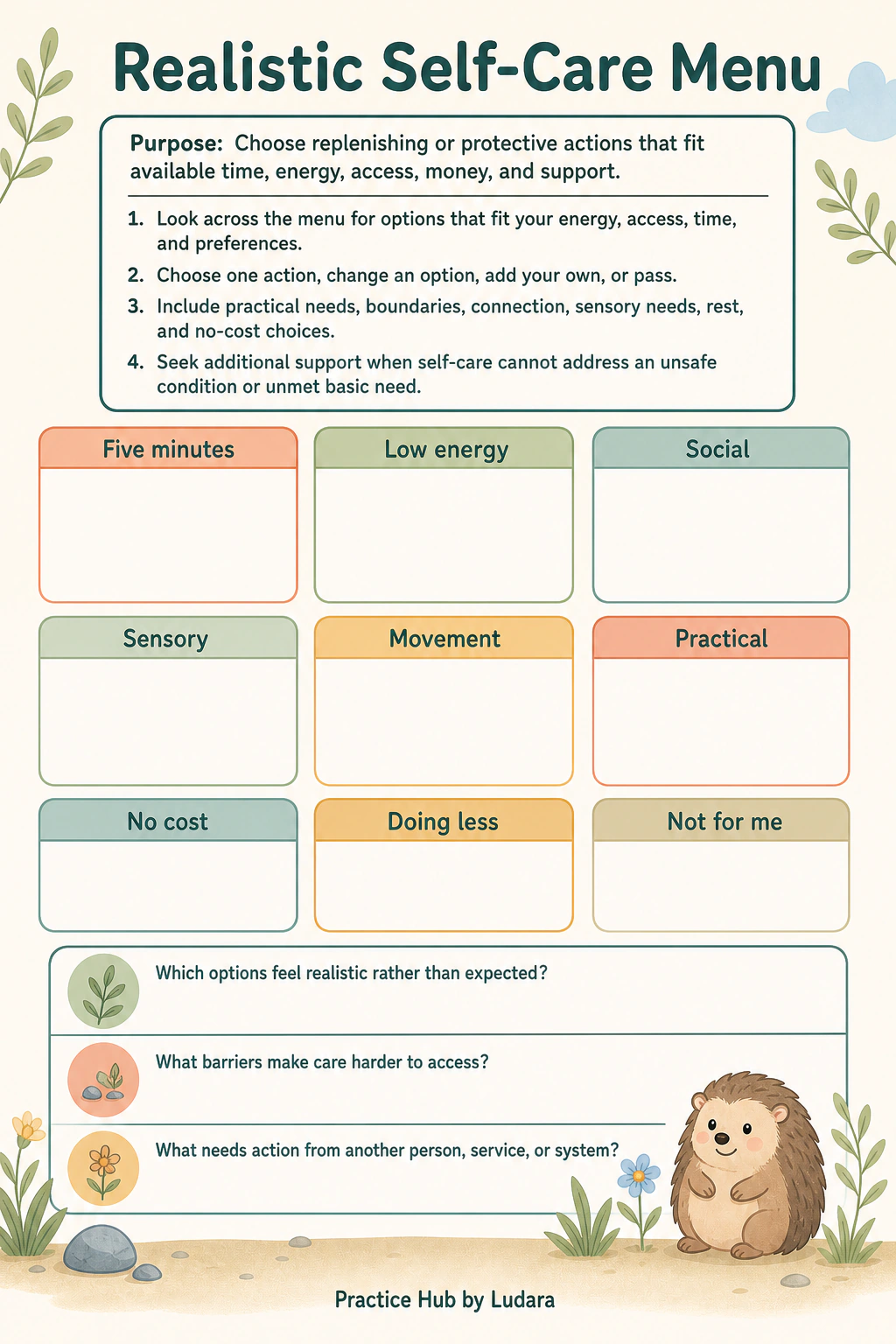
Realistic Self-Care Menu
Choose an action that offers care or protection and fits the time, energy, money, access, and support you have.
For clinician-facilitated use
This is a professional resource, not a child-facing online service. A licensed clinician or other qualified adult must determine suitability, explain and adapt the activity, and supervise its use. Do not direct a child to access this webpage independently or enter client information.
An adult professional should download the full-resolution WebP, which includes margins for printing. Read the guidance below before using it.
How to use it
- Look across the menu for options that fit your energy, access, time, and preferences.
- Pick an action, change an idea, add one of your own, or pass.
- Include practical needs, boundaries, connection, sensory needs, rest, and no-cost choices.
- Seek additional support when self-care cannot address an unsafe condition or unmet basic need.

Questions to explore
- Which options feel realistic rather than expected?
- What barriers make care harder to access?
- What needs action from another person, service, or system?

Notes for the person facilitating
Frame self-care as one possible support, not a treatment, responsibility to cope with harm, or replacement for safety, healthcare, accommodation, or material resources.
Ways to adapt the activity
- Create low-energy, no-cost, private, social, and sensory-specific menus.
- Replace movement or sensory items with accessible equivalents.
- Include asking for help and reducing demands as valid options.
Professional use and fit
Before using this resource, a licensed clinician or other qualified adult should decide whether it fits the person, setting, goals, accessibility needs, and applicable local policies.