Play Therapy · PT-09
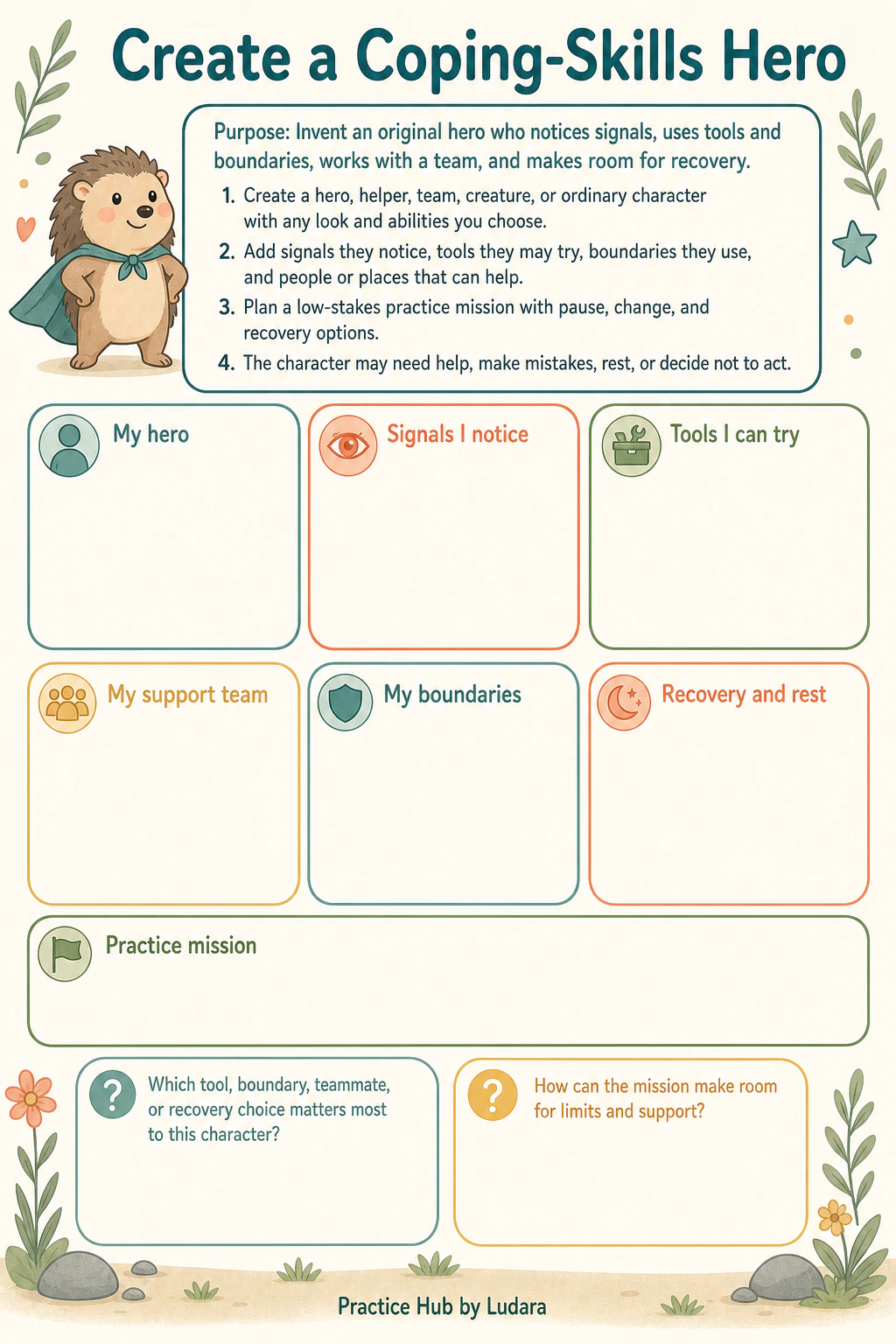
Create a Coping-Skills Hero
Invent an original hero who notices signals, uses tools and boundaries, works with a team, and makes room for recovery.
Clinician-created · facilitator review requiredFor clinician-facilitated use
This is a professional resource, not a child-facing online service. A licensed clinician or other qualified adult must determine suitability, explain and adapt the activity, and supervise its use. Do not direct a child to access this webpage independently or enter client information.
The full-resolution WebP includes print-safe margins and should be downloaded by an adult professional. Read the guidance below before using the page.
How to use it
- Create a hero, helper, team, creature, or ordinary character with any look and abilities you choose.
- Add signals they notice, tools they may try, boundaries they use, and people or places that can help.
- Plan a low-stakes practice mission with pause, change, and recovery options.
- The character may need help, make mistakes, rest, or decide not to act.

Reflection prompts
- Which tool, boundary, teammate, or recovery choice matters most to this character?
- How can the mission make room for limits and support?

Facilitator guidance
Emphasize interdependence, realistic limits, consent, repair, and rest rather than invulnerability, rescue, fighting, or individual responsibility for unsafe systems. Keep characters original and avoid evaluating the child through the hero's design.
Adaptations & accessibility
- Create a team, inventor, caregiver, animal, vehicle, place, or non-hero character.
- Include adaptive equipment, communication tools, sensory supports, and nonviolent powers.
- Use collage, dictation, AAC, pre-drawn parts, or shared design.
Professional-use review
Licensed play-therapy, disability-representation, and intellectual-property review required before use; avoid savior narratives, invulnerability, violence, copyrighted resemblance, and symbolic over-interpretation.