
Asana
A work-management platform for repeatable projects, ownership, approvals, and operational visibility outside the clinical record.
Review date
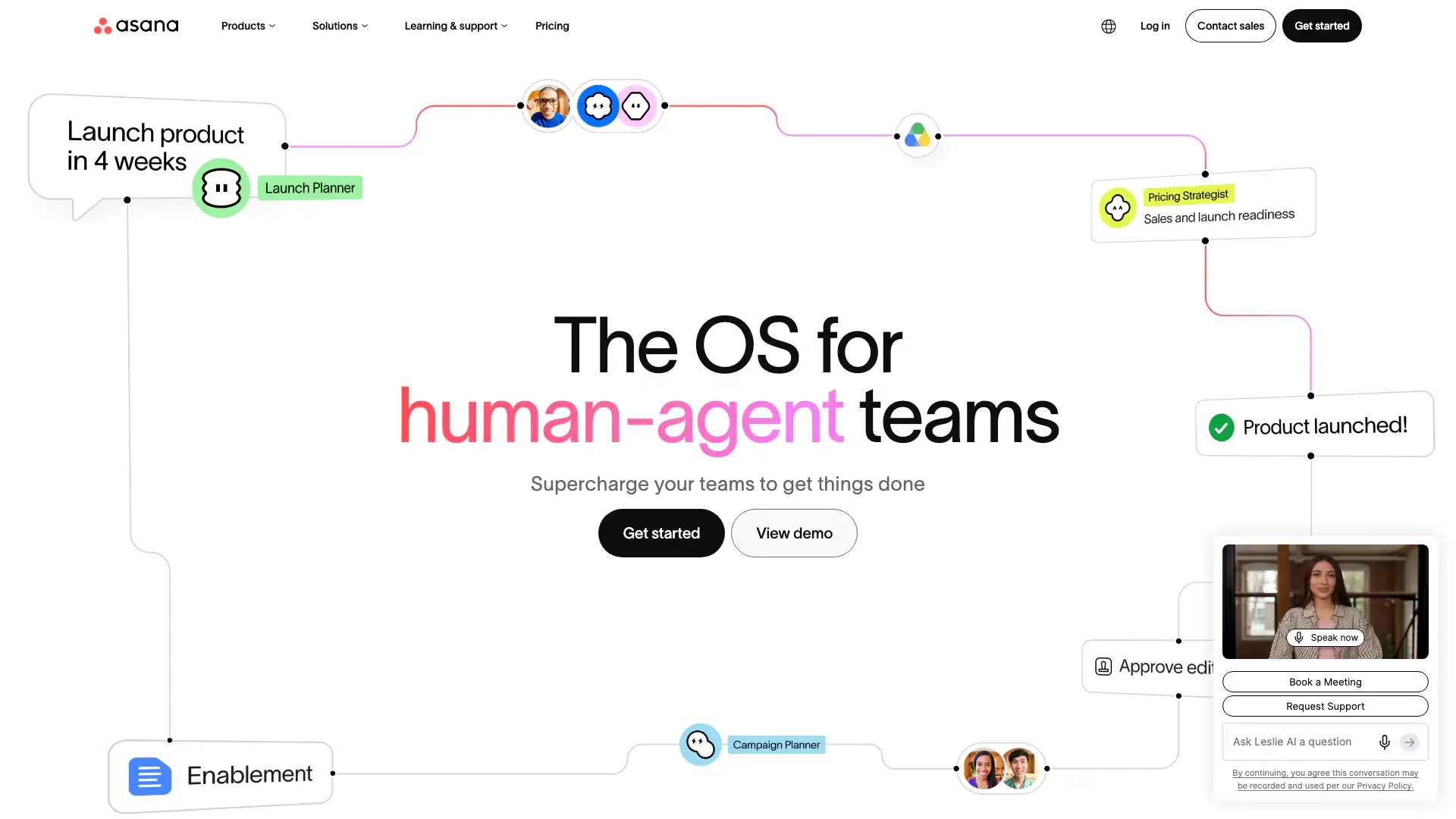
How Asana presents the product
Asana presents a shared work-management system for coordinating projects, recurring processes, owners, dates, and reporting.
- Company emphasis
- Projects, tasks, workflow templates, forms, rules, goals, portfolios, and reporting.
- Useful for
- Recognizing the product and preparing a focused demonstration with sample information.
- Evidence boundary
- This is first-party marketing material. It does not independently verify plan access, security, privacy, accessibility, exports, contracts, or practice fit.
Evidence / source sheet
Current evidence snapshot
Public vendor material and linked outside-review context last checked on .
$0
Personal plan$54.95
five Starter seats billed annually4.4/5 · 13,500+ reviews
G2Documentation reviewed
Trial + contract checks remainEvidence boundary
Reviewed does not mean hands-on approved.
Vendor documentation and outside reviews are starting evidence—not security approval, compliance certification, or a purchase recommendation.
Practice fit
Where it may fit—and where to slow down.
Reasons to shortlist
- Strong task ownership and recurring-work patterns
- Forms, templates, reporting, and automation on paid plans
- Large independent-review sample
Questions to pressure-test
- Do not place PHI in a general operations system without approved contract and configuration
- Flexible setup can become inconsistent without templates and an owner
- Advanced features and paid seats can raise cost
Security and administration
Turn claims into trial tasks.
Use sample information—not real client or staff details—when testing the product. Ask the vendor to demonstrate the exact plan and contract you are considering.
MFA
Trial checkTest administrators, members, guests, project privacy, and departing-user cleanup.
Roles & permissions
Trial checkCompare owner, clinician, administrator, biller, supervisor, and departing-user access in the exact plan.
Data exports
Trial checkExport projects, tasks, comments, attachments, custom fields, and audit data where licensed.
Account deletion
Contract checkConfirm termination, retention, deletion timing, subprocessor copies, and access after closure in writing.
Backup / restore
Contract checkDocument recycle, restore, retention, and any independent backup approach.
Accessibility
Trial checkKeyboard-test task creation, assignment, forms, search, board/list views, and notifications.
Administrative controls
Trial checkTest configuration ownership, audit history, role changes, support escalation, and offboarding.
DocumentedSupported by current first-party material.
Trial checkObserve it in an authorized trial using sample information.
Contract checkConfirm it in the exact agreement or BAA.
Pricing and reviews
Price the practice you actually run.
Start with the published price, then add the people, features, support, and services your practice would actually use.
Personal $0; Starter $10.99; Advanced $24.99 per user/month billed annually
Monthly billing costs more. Paid features, AI credits, guest rules, and seat assignment should be confirmed for the actual workflow.Independent review starting points
G24.4/5 · 13,500+ reviews↗CapterraRead current work-management reviews↗Use ratings as context, not a ranking. Read recent positive, critical, and role-relevant reviews.
Contract and demo record
Five questions worth getting in writing.
- Which features, roles, storage, usage, support, and security controls are included in this exact plan?
- What can we export without vendor help, in which formats, and what would be missing?
- How are backups tested, and how would we request a restore after an error or incident?
- What happens to our data, subprocessor copies, and account access after termination?
- Which accessibility standards and test results cover owner, staff, and client workflows?